
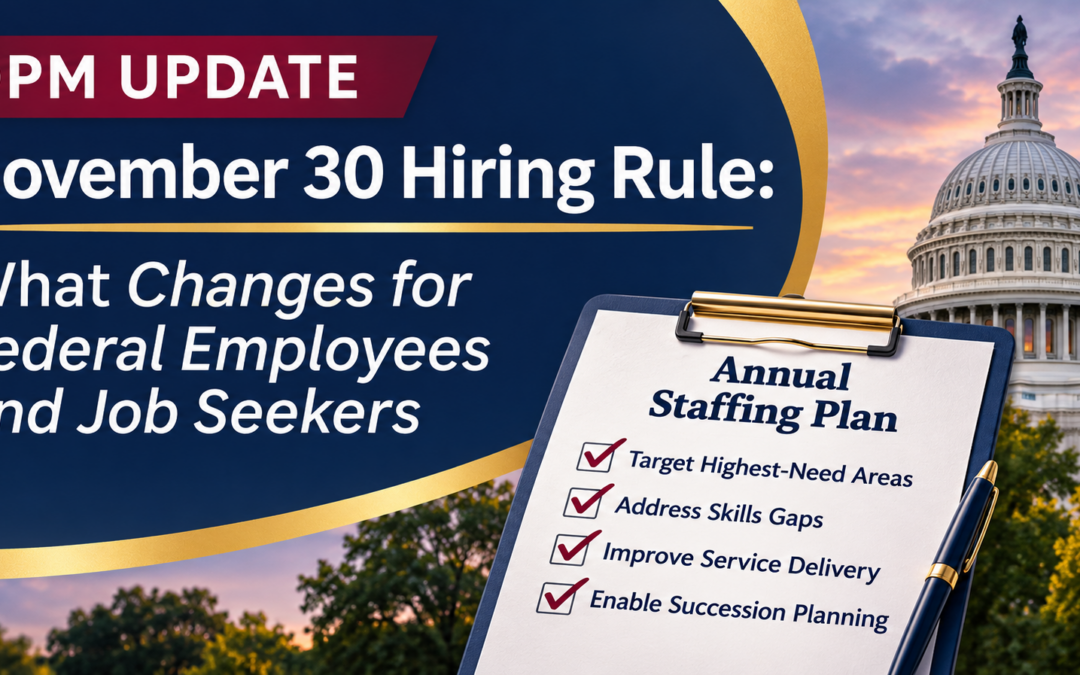
For federal employees and federal job seekers targeting GS-12 to GS-15 roles
| OVERVIEW
OPM finalized a new personnel management rule on October 29, 2026. It takes effect on Monday, November 30, 2026. Each agency will direct hiring to its highest-need positions through an Annual Staffing Plan. A Strategic Hiring Committee will oversee that hiring. My recommendation is to target page 1 of your resume to the announcement and substantiate your qualifications with documented results. |
What You Will Discover
- What OPM published on October 29, and what takes effect on November 30
- Who sits on your agency Strategic Hiring Committee, and what it cannot do
- How the Annual Staffing Plan changes where hiring goes first
- What replaces the Federal Employee Viewpoint Survey, and the 10 questions, word for word
- My take on Section 250.205, and why public results matter
- Five moves to make now, while agencies set their plans
Are you preparing for your next federal career move? If so, you need to know what the OPM November 30 hiring rule changes. OPM published the final rule in the Federal Register on October 29, 2026. It amends 5 CFR Part 250, the rules for personnel management in agencies. The citation is 91 FR 68013, docket OPM-2026-0368, RIN 3206-AO77.
First, a little background. OPM proposed the rule on July 2, 2026, and received nine public comments. In response, OPM made targeted revisions. Director Scott Kupor then sent agency heads an implementation memo on November 10, 2026. Finally, the rule takes effect on Monday, November 30, 2026.
OPM consolidated three overlapping planning products into one fiscal-year cycle, established the Strategic Hiring Committee in regulation, strengthened the role of the Chief Human Capital Officer (CHCO), and replaced the governmentwide Federal Employee Viewpoint Survey (FEVS). Let’s look at what these changes mean for your career.
What Did OPM Replace With the November 30 Hiring Rule?
In short, OPM replaced three planning and review products with three new ones. As a result, the staffing cycle aligns with the budget cycle.
| Before this rule | Under this rule |
| Human Capital Operating Plan (HCOP) | Annual Staffing Plan (ASP) |
| Human Capital Review (HCR) | Annual Staffing Review (ASR) |
| HRStat quarterly reviews | Quarterly Staffing Plan Performance Reviews |
The Annual Staffing Plan is the agency’s operational workforce plan. Specifically, it aligns with the agency strategic plan, annual performance plan, budget, President’s Management Agenda, and Human Capital Framework. OPM and the Office of Management and Budget jointly run the Annual Staffing Review. Meanwhile, the CHCO coordinates quarterly reviews with the Performance Improvement Officer and Strategic Hiring Committee. Where practicable, agencies may incorporate these reviews into existing quarterly performance reviews.
Who Sits on the Strategic Hiring Committee?
Each agency covered by the committee requirement must establish and maintain a Strategic Hiring Committee. Specifically, the regulation requires the Deputy Secretary (or equivalent), the chief of staff to the agency head, and the agency CHCO. In addition, agencies may appoint other members.
However, there is an important distinction: the committee has governance authority only. It has no examining, rating, or certification authority. In other words, it does not score your application, rank you against other candidates, or certify a list of eligible applicants. Those functions remain within the regular hiring process.
Instead, the committee oversees hiring to ensure it aligns with agency mission needs and the approved Annual Staffing Plan. Think of it as a steering group for where hiring goes, not a selection panel for who gets hired.
What Must the Annual Staffing Plan Actually Do?
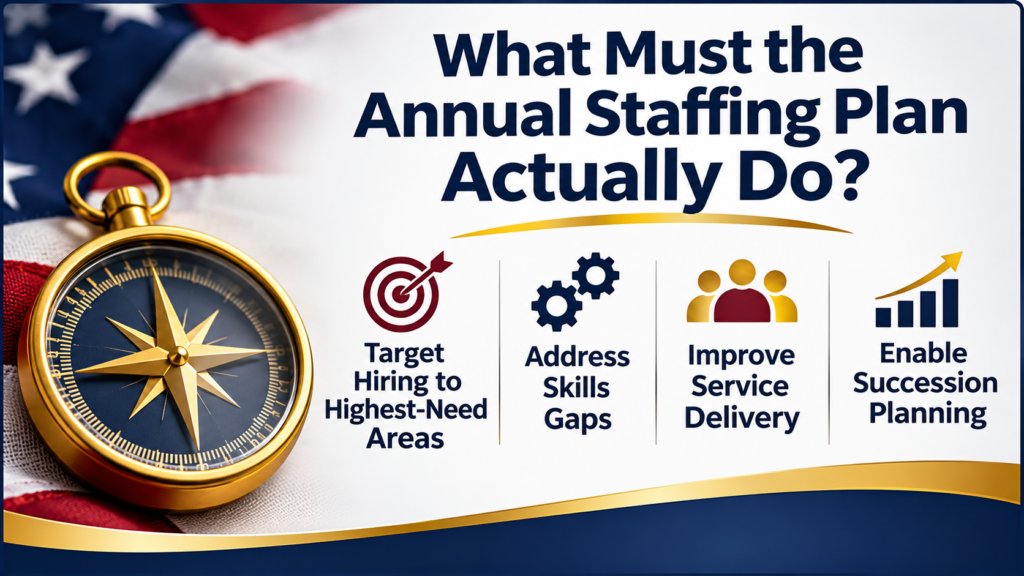
Under Section 250.205, the Annual Staffing Plan must target hiring to the highest-need areas. Specifically, it must address skills gaps, enhance service delivery, and enable succession planning. New appointments in the coming year must target those highest-need areas.
How These Priorities Relate to Your Career
I particularly like Section 250.205 because it connects hiring to agency needs rather than simply filling vacancies. With that in mind, here is how I recommend applying these priorities to your own career strategy.
First, the plan must address skills gaps. Therefore, I recommend identifying the expertise the announcement calls for. Then, demonstrate your relevant qualifications and accomplishments on page 1 of your resume.
Second, the plan must enhance service delivery. For example, think about how your work improved the services your agency delivers. Can you quantify that improvement? More importantly, help the reader understand the difference your work made.
Third, the plan must enable succession planning. Similarly, I encourage you to prepare for your own next career move. Keep a current Bullet Bank of accomplishments so you are ready when a promotion or another right-fit opportunity presents itself.
In addition, Section 250.303 establishes a separate requirement for public survey results. Agencies generally must publish results unless the agency head determines that national security warrants withholding them. However, the content of public disclosures may vary. Therefore, consider the available results as one source of information when evaluating an agency.
How Agencies Track Staffing Plan Progress
Meanwhile, the CHCO coordinates the plan with the Chief Financial Officer and Chief Operating Officer, with senior leadership involved. At the start of each quarter, agencies send OPM and OMB an update. Specifically, each update shows progress and explains any major variance.
In addition, the final rule introduces a written certification at each Annual Staffing Review. The agency head must certify that the CHCO has the required visibility, oversight, and control. If a gap exists, the agency must document it and provide a timeline for addressing it. In other words, the agency head puts CHCO authority on the record.
What Happens to the Federal Employee Viewpoint Survey?
The governmentwide Federal Employee Viewpoint Survey is ending. Instead of OPM administering FEVS governmentwide, each agency runs its own Annual Employee Survey. Specifically, Sections 250.302 and 250.303 establish the survey requirements. These requirements apply to all executive agencies.
The core question set shrinks from 16 questions to 10. However, agencies may add their own questions to the 10 prescribed questions. Within 90 days after survey administration ends, agencies must send results to OPM and OMB. In addition, agencies must post results publicly on their websites, subject to the national security exception.
What Are the 10 Required Survey Questions?
Here are the 10 prescribed questions, from Section 250.302(a)(2). Every agency survey must use them.
- Managers clearly communicate the goals of the organization.
- The people I work with cooperate to get the job done.
- In my work unit, differences in performance are recognized in a meaningful way.
- My supervisor provides ongoing feedback to help me succeed and progress in my career.
- My supervisor holds my team accountable for achieving results.
- I know how my work relates to the agency’s goals.
- I feel empowered to get things done at my organization.
- I can disclose a suspected violation of any law, rule or regulation without fear of reprisal.
- In my work unit, steps are taken to deal with a poor performer who cannot or will not improve.
The tenth question is different. It asks: In my work unit, poor performers usually (select all that apply):
- Remain in the work unit and improve their performance over time
- Remain in the work unit and continue to underperform
- Leave the work unit (removed or transferred)
- Leave the work unit (quit)
- There are no poor performers in my work unit
Why OPM Changed the Survey
Together, these questions cover goals, cooperation, feedback, accountability, and recognition of performance. OPM explained that FEVS had become a check-the-box activity without enough actionable insight. Therefore, the shorter, agency-run survey aims to put feedback closer to the managers who can act on it. However, whether that approach works depends on each agency.
Which Agencies Does This Cover?
The committee, plan, and review requirements cover nearly every agency. However, four are excepted: the Central Intelligence Agency, Government Accountability Office, United States Postal Service, and Postal Regulatory Commission. In contrast, the annual survey requirements apply to all executive agencies.
During the comment period, some commenters warned that senior-level hiring committees could politicize hiring. In response, OPM clarified that committee oversight is a governance and workforce planning function. Furthermore, committee members remain subject to the merit system principles in 5 U.S.C. 2301 and prohibited personnel practices in 5 U.S.C. 2302. FEDweek reported the same point on November 12, 2026.
What Does Highest-Need Hiring Mean for Your Resume?
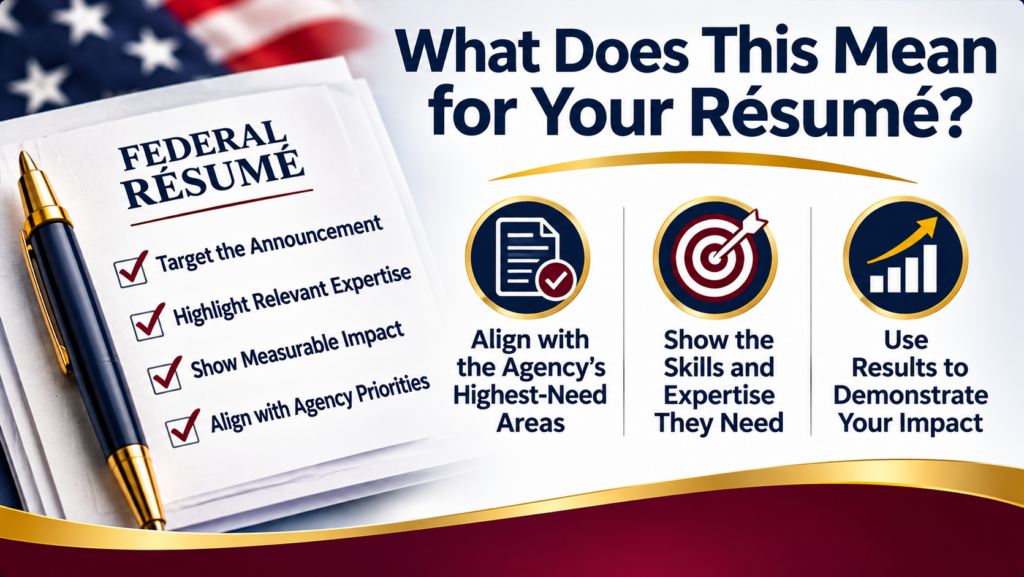
The rule does not establish new resume requirements or change how your qualifications are evaluated. However, I recommend using the announcement to identify the agency’s needs and demonstrate how your experience aligns with them. After all, a generic resume makes that connection harder for the reader to see.
Don’t just tell the agency what you’ve done. Demonstrate how your experience, expertise, and accomplishments align with what the agency needs.
Make Page 1 Interview-Worthy
This is where my Page 1 Method™ comes in. First, make page 1 of your federal resume interview-worthy. Address the qualifications in the announcement in order, using your most relevant accomplishments. Then, use page 2 to substantiate your qualifications with dates, scope, metrics, and supporting evidence.
For example, my article, Prime Time or Frankensteined Federal Resume?, walks you through customizing page 1 to the announcement and front-loading your accomplishments with metrics.
Remember, an Annual Staffing Plan is an agency workforce planning requirement, not an applicant evaluation standard. Therefore, you cannot assume that a particular announcement reveals every staffing priority. However, you can control how clearly your resume demonstrates your qualifications and the value you bring to the role.
Build Your Bullet Bank Before You Need It
Have you started your Bullet Bank of accomplishments? If not, start now and continue adding to it as you progress in your career. Using my STCARI Story Method™, lead with Impact, Results, and Action. Then, capture supporting details while they are fresh. As a result, your Bullet Bank becomes a valuable resource for performance appraisals, targeted applications, and interview preparation.
Make page 1 of your federal resume interview-worthy. Use page 2 to substantiate your qualifications with evidence.
For additional guidance, read how to prove your qualifications on a resume. It shows how to write accomplishments using Impact, Results, and Action, and how to support each one with evidence.
What Should You Do Now?
The rule takes effect on Monday, November 30. With that in mind, here are five steps you can take to prepare for your next career move.
- Target the stated need. First, read the announcement carefully. What problem does the agency need someone to solve? Then, ask yourself whether page 1 of your resume demonstrates your relevant qualifications.
- Rebuild page 1, and back it up on page 2. Start with one role at a time. Specifically, address each qualification in the announcement and lead with your closest match to the specialized experience. Next, move older or unrelated duties down, or cut them. Finally, use page 2 to substantiate page 1 with dates, scope, and results. In my experience, one strong, targeted application is a better strategy than ten broad ones.
- Build your Bullet Bank of accomplishments. Start or refresh your Bullet Bank this week. For each accomplishment, lead with Impact, Results, and Action. Then, keep adding to it as you progress in your career, while the details are fresh.
Prepare for Future Opportunities
- Ask what your agency has shared. For example, has your agency shared its Annual Staffing Plan priorities or information about its Strategic Hiring Committee? If so, use that information to better understand where the agency intends to focus its hiring.
- Prepare before the posting. Rather than waiting for your next right-fit role to open, build your accomplishment record and get the guidance you need now. That way, you will be better prepared to tailor your resume when the opportunity presents itself.
If you would like expert guidance positioning yourself for your next federal career move, apply to partner with me. Together, we can develop a strategy that helps you demonstrate your qualifications and communicate the value you bring.
Where Does This Leave You?
The November 30 rule focuses on agency workforce planning and hiring oversight. However, it does not give the Strategic Hiring Committee authority to rate or certify your application. With that in mind, my advice is to apply with intention, target your resume to the announcement, and keep your Bullet Bank of accomplishments current. You’ve got this, and I’ve got you. #KeepGoing
The Bottom Line
OPM published the final rule on October 29, 2026, at 91 FR 68013. It takes effect on Monday, November 30, 2026.
Importantly, each agency Strategic Hiring Committee holds governance authority only. It does not rate, rank, or certify applicants.
Meanwhile, Annual Staffing Plans direct hiring to highest-need positions, address skills gaps, enhance service delivery, and enable succession planning.
In addition, the governmentwide FEVS ends. Instead, agencies run their own survey with 10 core questions, down from 16.
Ultimately, my recommendation: use a targeted page 1 and a current Bullet Bank of accomplishments to communicate your qualifications. These are career strategies, not new regulatory requirements.

Frequently Asked Questions
When does the OPM November 30 hiring rule take effect?
The rule takes effect on Monday, November 30, 2026. OPM published it in the Federal Register on October 29, 2026, at 91 FR 68013. It amends 5 CFR Part 250.
What is a Strategic Hiring Committee?
A Strategic Hiring Committee is a senior group each agency must maintain to oversee hiring. It includes the Deputy Secretary or equivalent, the chief of staff to the agency head, and the Chief Human Capital Officer. It ensures hiring matches mission needs and the Annual Staffing Plan.
Can the Strategic Hiring Committee rate or rank my application?
No. The committee has governance authority only. It has no examining, rating, or certification authority. Rating, ranking, and certification stay in the regular hiring process.
What is an Annual Staffing Plan?
In short, an Annual Staffing Plan is the agency operational workforce plan for the fiscal year. It replaces the Human Capital Operating Plan. The plan targets hiring to highest-need areas, skills gaps, service delivery, and succession planning.
What replaces the Federal Employee Viewpoint Survey?
Each agency now runs its own Annual Employee Survey using 10 prescribed questions, down from 16. Agencies send results to OPM and OMB within 90 days after administration ends and generally publish results, subject to the national security exception.
Which agencies are excepted from the committee and plan requirements?
Four agencies are excepted: the Central Intelligence Agency, the Government Accountability Office, the United States Postal Service, and the Postal Regulatory Commission. The annual survey requirements apply to all executive agencies.
What are the 10 survey questions?
Section 250.302(a)(2) prescribes 10 questions covering goals, teamwork, recognition, feedback, accountability, empowerment, protected disclosures, and poor performance. For the exact wording, see the section “What Are the 10 Required Survey Questions?” above.
How should I change my resume under this rule?
Build page 1 of your resume to answer each qualification in the announcement. Build page 2 to back up page 1 with evidence to support it. Write each accomplishment with the impact, the result, and the action. Keep a current Bullet Bank of accomplishments to draw from.
About the Author
Camille Roberts is the founder and Chief Career Strategist of CC Career Solutions, LLC, with more than 30 years of experience in federal and executive career strategy. She holds 18 industry certifications and has won numerous industry awards. Camille is most proud, though, of helping thousands of clients across more than 400 federal agencies, and in private sector, position themselves and land their best next move.
Sources
- Office of Personnel Management. Personnel Management in Agencies: Strategic Human Capital Management. Final rule, Federal Register, October 29, 2026, 91 FR 68013, Document 2026-22093, 5 CFR Part 250, RIN 3206-AO77, Docket ID OPM-2026-0368. https://www.federalregister.gov/d/2026-22093
- Office of Personnel Management. Final Regulations on Personnel Management in Agencies and Strategic Human Capital Management. Memorandum from Director Scott Kupor to Heads and Acting Heads of Departments and Agencies, November 10, 2026. https://www.opm.gov/chcoc/latest-memos/final-regulations-on-personnel-management-in-agencies-and-strategic-human-capital-management.pdf
- FEDweek. Final Rules on Staffing Planning, Oversight by Appointees Take Effect November 30. November 12, 2026. https://www.fedweek.com/federal-managers-daily-report/opm-finalizes-rules-on-staffing-planning-oversight-by-appointees/
- OPM Employee Survey Playbook, July 2026 (supplemental resource; confirm official link before publishing).
- Update: OPM November 30 Hiring Rule: What Changes for Federal Employees and Job Seekers - November 25, 2026
- “Any of Them”: A September 11 Memory, and What We Owe Each Other Now - September 11, 2026