

What Christopher Columbus’s 1492 voyage can teach you about today’s job market, especially when your career doesn’t go as planned + a 5-Point Job Search Checklist is waiting for you at the end.
On October 12, 1492, Christopher Columbus and his crew reached land after crossing the Atlantic Ocean. Their arrival marked a turning point in history, but not the outcome Columbus had originally planned.
There was just one problem: he wasn’t where he thought he was. Columbus intended to reach Asia by sailing west, but he arrived in the Caribbean, on islands already inhabited by Indigenous peoples. That unexpected destination is why I want you to rethink what success can mean for your career.
He had pursued his objective for years, secured financial backing, assembled three ships, and navigated the Atlantic. Yet he never reached the destination he originally intended.
These career lessons from Christopher Columbus raise a question I want you to consider in 2026: Can you miss the destination you planned and still achieve something valuable? Yes, but only if you understand what you truly want from your career.
The distinction is between the job title you initially selected and the compensation, responsibilities, working conditions, and career growth you want that job to provide.
After decades of helping professionals navigate career transitions, promotions, federal hiring, and private-sector opportunities, I’ve seen this distinction make an enormous difference.
You can become so focused on one position that you overlook opportunities offering stronger compensation, better working conditions, meaningful responsibilities, or a more fulfilling career.
You might also keep pursuing the same strategy long after the evidence suggests it isn’t working. That’s why I believe there are five important career lessons from Christopher Columbus and his 1492 voyage that modern job seekers can apply.
Before we examine them, it’s important to acknowledge the full historical context. Columbus did not discover an uninhabited land. Indigenous civilizations already lived throughout the Americas, and the European colonization that followed brought devastating consequences for their communities.
We can examine the decisions surrounding the voyage, including its failures and unexpected outcomes, without overlooking that history.

Lesson 1: Career Lessons from Christopher Columbus About Changing Your Destination
Columbus wanted to reach Asia and believed sailing west would provide a more direct route. His confidence in that destination did not make his geographic assumptions correct.
He was wrong about the geography, but his voyage led to an outcome he had not anticipated. For Spain, that outcome eventually opened enormous commercial and political opportunities. For Indigenous peoples, it led to catastrophic consequences. The historical outcome was not an unqualified success.
Here is the career lesson from Columbus that I want you to consider: missing your original destination does not automatically mean your career plan has failed. Imagine you have spent 15 years working in the federal government. You are qualified for a deputy director position, have led successful projects, supervised teams, and pursued promotions.
Despite your experience, the promotion still has not materialized. What happens next? You could keep applying for the same positions with the same strategy, hoping the next application produces a different outcome.
Or you could evaluate your experience from a broader perspective. Perhaps your leadership, regulatory, program management, and stakeholder engagement experience would be highly valued by a government contractor, consulting firm, or private-sector organization.
An opportunity you weren’t originally considering might offer more responsibility, greater flexibility, or a more attractive compensation package.
Does that mean you should abandon your federal career? Not necessarily. It means you should evaluate opportunities based on your desired career outcome, not just on the title you originally had in mind.
What Is the Difference Between Your Career Target and Your Desired Outcome?
I want you to distinguish between a career target and the outcome you want from it. This is a planning exercise, not a recommendation to put an outdated objective statement on your résumé.
Your career target is the position you want to pursue, based on the opportunities and qualifications in front of you.
Your desired career outcome is what you expect that position to provide, such as meaningful work, greater responsibility, strong benefits, advancement, or compensation.
Those are not always the same thing, which is precisely why your job search deserves periodic reassessment. For example:
- Job target: A GS-15 deputy director role.
- Desired career outcome: Lead significant initiatives, earn competitive compensation, influence organizational decisions, and continue advancing.
Or:
- Job target: A vice president of operations role.
- Desired career outcome: Exercise enterprise-level leadership, increase compensation, build organizational influence, and prepare for executive responsibility.
A job title is one possible route, while a desired career outcome describes what you actually want. That distinction is central to these career lessons from Christopher Columbus, because the destination on your map may not be the best opportunity available.
What You Can Do Today
Type the position you’re currently targeting into your notes. Then answer three questions:
1. What do I expect this position to give me that I don’t have today?
2. Could another position, employer, or industry provide those same benefits?
3. Am I evaluating opportunities based on their actual value, or am I attached to a particular title?
You may discover that you’ve been limiting your opportunities without realizing it.
“Your accomplishments have value, but decision-makers need to understand that value.”
Lesson 2: How Do You Get Decision-Makers to Recognize Your Value?
Columbus didn’t simply announce that he wanted to sail west and expect someone to provide ships and money. He needed sponsorship. His proposal faced years of resistance before Spain’s monarchs, Ferdinand and Isabella, agreed to support the expedition.
Whatever we think of his objective, one practical observation remains: a large ambition requires resources, credibility, and the ability to persuade others to support it.
The same principle applies when you seek a promotion, change employers, or pursue a completely different field.
I’ve encountered many highly qualified professionals who assume their accomplishments should speak for themselves.
You work hard, take on additional responsibilities, solve problems, train coworkers, and deliver results. You may be surprised when someone with less experience receives the promotion or job offer. When that happens, the problem may not be your qualifications. You may need to examine how effectively you communicate your experience.
A positioning gap can prevent an employer from connecting your accomplishments to the results that employer needs.
Your accomplishments have value, but decision-makers need to understand that value.
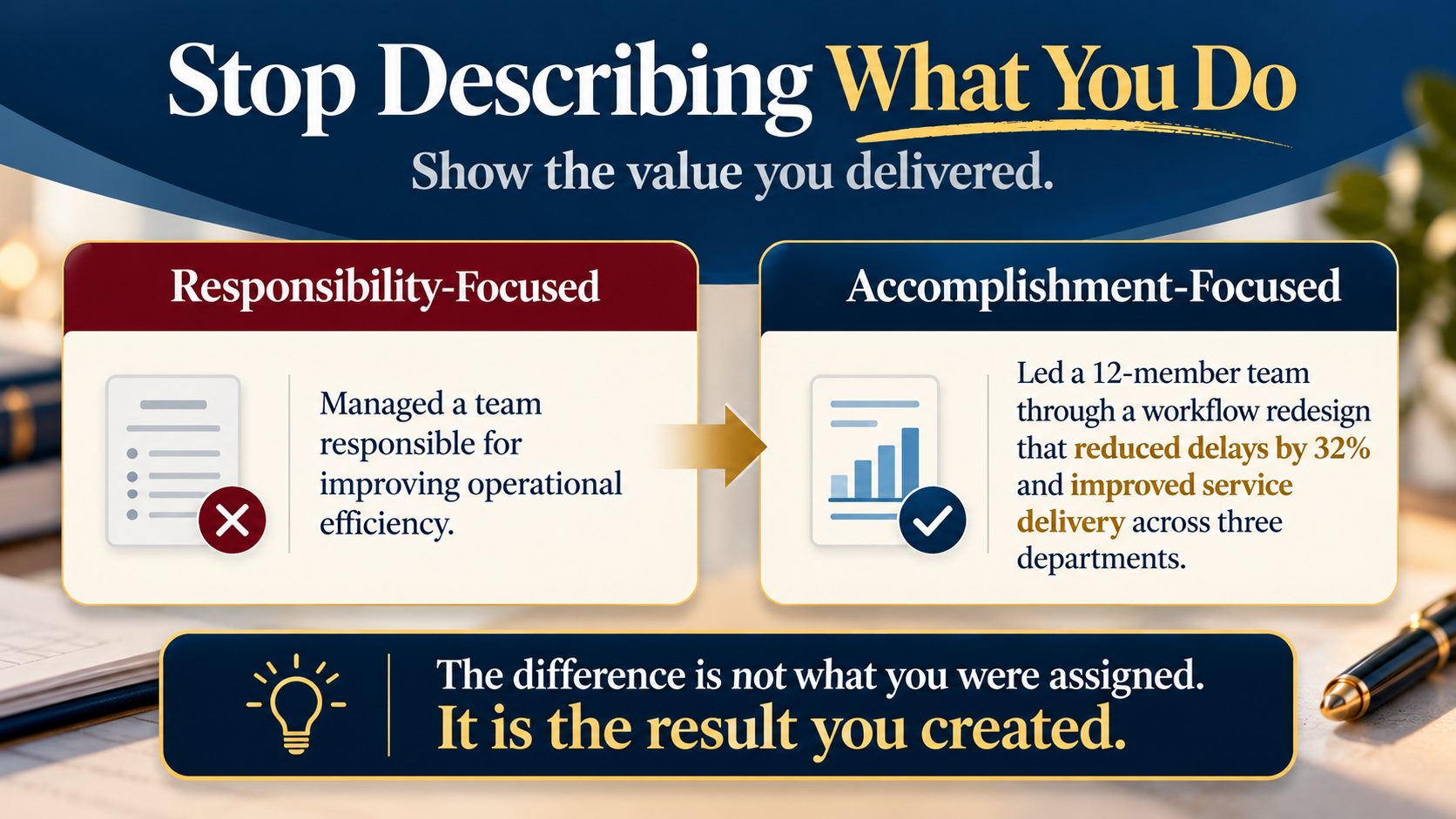
Stop Describing What You Do. Start Demonstrating What You Accomplish.
Consider the difference between these two statements.
Responsibility-focused: Managed a team of employees responsible for improving operational efficiency.
Accomplishment-focused: Led a 12-member team through a workflow redesign that reduced processing delays by 32% and improved service delivery across three departments.
The second example is illustrative, but notice the difference. It identifies leadership scope, the problem addressed, the action taken, and the measurable outcome. That’s the type of evidence hiring managers and promotion panels need. The same principle applies when you’re requesting a promotion, building your LinkedIn profile, preparing for an interview, or pursuing a new career direction.
Don’t expect decision-makers to figure out why you’re valuable. Make the connection for them.
What You Can Do Today
Review your résumé or LinkedIn profile. Identify three statements that describe responsibilities rather than accomplishments. For each one, ask:
- What problem was I responsible for solving?
- What did I personally do?
- What improved because of my work?
- How can I substantiate the result?
Then revise the statement to demonstrate your contribution. If you don’t have a measurable percentage or dollar amount, don’t invent one. Scope, complexity, quality, risk reduction, and documented improvements can also establish value.
“Persistence is valuable. Persisting with incorrect assumptions is not.”
Lesson 3: When Should You Change Your Job Search Strategy?
One of the most practical career lessons from Christopher Columbus is that determination does not correct flawed assumptions. He expected to reach Asia by sailing west across the Atlantic, but he underestimated the distance involved.
Now think about what happens in a modern job search. You apply for 150 positions over several months, receive a handful of interviews, get no offers, and start seeing generic rejection emails. At that point, the answer is not simply to apply for 150 more positions before you evaluate what may be going wrong.
Repeated activity is not necessarily evidence of an effective job search strategy. There could be several reasons you are not getting traction:
- The positions may not align with your strongest qualifications.
- Your résumé may not demonstrate the requirements employers are seeking.
- Your career positioning may be too broad or unclear.
- Your interview responses may not communicate accomplishments effectively.
- Your compensation or work arrangement expectations may not align with available opportunities.
- You may be concentrating on a shrinking market while overlooking growing areas of demand.
The answer is not automatically to apply to more positions. First, examine the evidence you have already collected.
You may need to change your job targets, strengthen the evidence in your résumé, or improve the way you communicate your results.
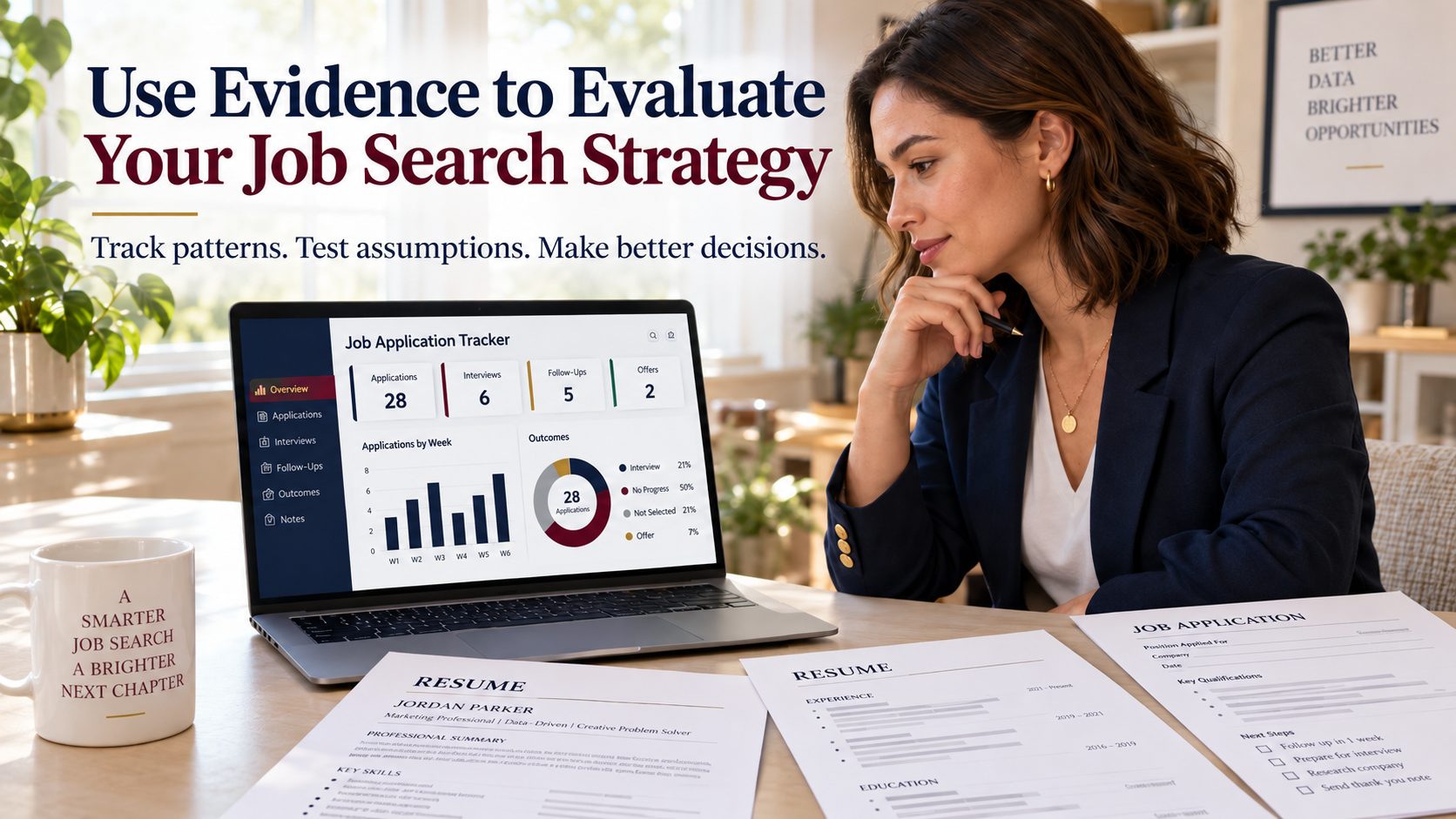
Use Evidence to Evaluate Your Job Search Strategy
Evaluate your job search the way you would an important business initiative. Track how many positions you have applied for and how many resulted in interviews. Then consider how often you advance and where opportunities fall apart. That information helps you choose what to adjust.
If you’re consistently reaching interviews but not receiving offers, examine your interview preparation, accomplishment stories, and how effectively you’re communicating your value.
These patterns don’t establish a diagnosis on their own, but they tell you where to investigate. And remember, external factors matter. Hiring freezes, competition, changing requirements, canceled positions, and organizational budgets can affect results even when your strategy is sound.
What You Can Do Today
Review your last 10 applications. Look for patterns in the positions, qualifications, responses, and outcomes. Identify one assumption you’ve been making about your job search. Then determine how you can test whether it’s correct.
Lesson 4: How Do You Know When to Stay the Course or Change Direction?
Crossing the Atlantic in 1492 involved significant uncertainty, including navigational challenges and anxiety about the voyage’s progress. Historical accounts describe tensions among the crew as the expedition continued westward.
Career changes can feel just as uncertain. You may wonder whether your qualifications transfer, whether a lateral move makes sense, or whether leaving federal service would put your benefits at risk. Those concerns deserve careful evaluation, not automatic dismissal.
You may have people telling you to stay where you are. You may question whether your qualifications will transfer. You may wonder whether you’re risking the security you’ve spent years building. But here’s something important. There is a difference between making a difficult decision and making a poorly informed decision. You don’t have to eliminate every uncertainty before taking action. You do need to understand the risks and gather enough evidence to make a reasonable decision.
Apply Three Principles to Difficult Career Decisions
1. Separate facts from assumptions.
Don’t assume you can’t qualify for a private-sector position because your experience is federal. Don’t assume a lateral move is a setback. And don’t assume a higher salary automatically makes a position better. Investigate the opportunity.
2. Evaluate the consequences.
Before changing employers or career paths, examine compensation, benefits, retirement implications, advancement potential, stability, location, and your personal priorities. For federal employees and transitioning military professionals, benefits and retirement considerations may be especially important.
3. Preserve your options where possible.
You don’t always have to resign before exploring another opportunity. You can research employers, build relationships, evaluate job requirements, strengthen your qualifications, and assess your marketability while remaining employed.
A thoughtful career transition is usually more effective than a decision made entirely out of frustration.
What You Can Do Today
Identify one career move you’ve been considering but haven’t pursued. List the three biggest risks. Then identify one action you could take to reduce each risk.
Career courage and career preparation should work together.
“The job you first wanted is not always the opportunity that best serves your future.”
Lesson 5: Can an Unexpected Career Opportunity Be Better?
Let’s return to October 1492. Columbus reached land, but not Asia. His arrival changed world history and had devastating consequences for Indigenous populations. That history matters when we decide what lessons to draw from the voyage.
For your career, the useful analogy is not that every unexpected arrival is a success. It is that a different destination gives you new evidence to consider. Do you keep defending an outdated plan, or do you reassess what you have learned and choose your next move accordingly?
Consider a Different Career Outcome
You may have spent years pursuing a director-level position within your current organization.
After several unsuccessful promotion attempts, you may need to evaluate your skills more broadly. You may discover that your experience leading cross-functional teams, managing multimillion-dollar budgets, improving operations, and advising senior leadership also qualifies you for positions in consulting and corporate operations.
You may pursue a different opportunity and receive an offer with stronger compensation, greater decision-making authority, and a clearer advancement path.
You may not receive the promotion you originally wanted, but you can still achieve the career outcome you were seeking. This is an illustrative example, not a claim about a particular client.
Your Transferable Accomplishments May Open Doors You Haven’t Considered
If you have spent most of your career in one sector, you may be overlooking relevant opportunities elsewhere. For example, federal experience in compliance, acquisition, cybersecurity, investigations, logistics, or program management can transfer to roles in other settings.
A military professional might bring substantial leadership, operational planning, training, risk management, and resource allocation experience.
A private-sector executive may have qualifications that translate into another industry, consulting, advisory work, or entrepreneurship.
The challenge is determining where those qualifications are relevant and how to communicate their value to a different audience.
Your next hiring manager may not recognize your previous titles or specialized terminology. That is why you need to translate your accomplishments into the problems an employer needs solved.
You need to translate your accomplishments into the problems that employer needs solved.
What You Can Do Today
Look beyond your current job title. Identify your five strongest accomplishments. For each one, determine:
- What business or organizational problem did I solve?
- What capabilities did I demonstrate?
- Which other employers or industries face similar problems?
- What positions require those capabilities?
- What evidence would I need to demonstrate my qualifications?
You may find that the career opportunities you’ve been overlooking are worth investigating.
Career Lessons from Christopher Columbus: Your Five-Point Job Search Checklist
Whether you’re actively searching for a job, seeking a promotion, transitioning from military service, or evaluating a career change, use these five questions to assess your current strategy.
1. Is my destination still the right one? Evaluate whether your target position supports your long-term desired career outcomes, not just the job title you’ve always wanted.
2. Have I demonstrated why someone should invest in me? Make sure your résumé, LinkedIn profile, professional relationships, and interview responses communicate the value you deliver.
3. Am I relying on assumptions that need to be tested? Use current job announcements, employer requirements, and your application results to evaluate whether your strategy is working.
4. Have I assessed the risks and opportunities? Consider the full implications of a career move, including compensation, benefits, advancement, stability, and personal priorities.
5. Am I overlooking a better destination? Identify alternative positions, industries, and career paths that could offer the outcomes you’re working toward.
What Are the Most Important Career Lessons from Christopher Columbus?
Christopher Columbus did not reach the destination he originally intended. That fact is a useful reminder to examine both your destination and the assumptions that are guiding you toward it.
His voyage also demonstrates that ambition and persistence are not substitutes for accurate information or sound judgment.
For modern job seekers, both lessons matter. You can have impressive qualifications, years of experience, a carefully prepared résumé, and a clear career goal.
You can also find yourself pursuing a position that isn’t the strongest opportunity available to you. That doesn’t mean your experience has lost its value. It may mean you need to reconsider where that value is most needed. After decades in career development, one thing I know is that professionals frequently have more transferable value than they recognize.
The challenge is identifying that value, positioning it effectively, and making informed decisions about where to take it next.
Don’t become so committed to a particular job title that you overlook the career outcome you’re actually trying to achieve.
Sometimes your next best move isn’t the destination you originally planned. It’s the opportunity you recognize when you’re willing to look beyond it.
Ready to Talk Through Your Next Career Move?
If you’ve been pursuing the same career target without getting the results you want, it may be time to step back, reassess your strategy, and talk through your options with someone who understands both the federal and private-sector job markets.
At CC Career Solutions, I help professionals identify their competitive value, assess opportunities, and position their qualifications for federal, private-sector, executive, and career-transition opportunities.
My holistic approach is grounded in evidence, individual qualifications, and strategic career decisions. You don’t have to abandon your career ambitions. You may need a clearer strategy for reaching them.
Request a Career Strategy Coaching Session: Partner with Camille
P.S. One final question: Are you pursuing the job title you’ve always wanted, or the career future that would actually serve you best?
Frequently Asked Questions About Career Changes and Job Search Strategy
What can Christopher Columbus’s voyage teach modern job seekers?
Columbus’s 1492 voyage illustrates the importance of ambitious goals, gaining support, evaluating assumptions, managing uncertainty, and responding to unexpected outcomes. For job seekers, the central lesson is to remain focused on meaningful desired career outcomes while being willing to reconsider the specific positions or paths used to achieve them.
Is changing career targets a sign of failure?
No. Changing career targets can be a sound strategic decision when new information reveals a better opportunity or shows that an existing plan no longer supports your priorities. The key is to make the change based on evidence rather than frustration alone.
How do I know if I’m targeting the wrong jobs?
Examine the alignment between your qualifications and actual job requirements, your application-to-interview results, and the responsibilities associated with your target roles. Consistently poor alignment or limited progress may indicate that your job targets, positioning, or application strategy need reassessment.
How can I identify transferable skills for a career change?
Start with your strongest accomplishments rather than your job titles. Identify the problems you’ve solved, the capabilities you’ve demonstrated, and the outcomes you’ve delivered. Then compare that evidence with the requirements of positions in other industries or sectors.
Should I keep applying for the same jobs if I’m not getting interviews?
Not without evaluating your approach. Review your qualifications, role selection, résumé, and application results. If the evidence indicates a persistent problem, make a targeted change and assess whether it improves your results.

She also partners with entrepreneurs and business owners, applying the same Magnetic Positioning™ principles to help them attract the right clients and referrals.
Her services include career marketing: federal and private-sector resumes, LinkedIn profiles, interview and salary negotiation strategy, one-sheets, company pages, outplacement support, and AI implementation.
She publishes Magnetize Your Career, a blog and LinkedIn newsletter for mid-career professionals and executives across federal government, private sector, and military.
Learn more at cccareersolutions.com.
You've got this, and I've got you.
#KeepGoing
- The Emotional Containment Principle: Staying Steady When Your Career Is in Transition - October 31, 2026
- You Could Qualify for a $315,000 Salary and Still Get Passed Over. Here’s Why + How to Fix - October 30, 2026
- What a $405,000/Annual AI Job and Senior Federal Roles Reveal About Magnetic Positioning™ - October 18, 2026