
Quick answer:
Effective leaders neither rebel against every boundary nor surrender to every limitation. They investigate the constraint, understand its purpose, and determine where responsible movement is still possible. That disciplined process is the Constraint Navigation Principle.
Key Takeaways
- A real constraint defines a condition. It does not automatically eliminate every path forward.
- Leaders must distinguish among fixed, flexible, assumed, and navigational constraints.
- Constraint navigation is not finding a way around the rules. It is finding the responsible path that still exists within them.
- AI illustrates how regulation, policy, uncertainty, and limiting beliefs can operate at the same time.
- Leaders do not need complete certainty before moving. They need enough clarity to take the next responsible step.
- My experience leading 35 employees after surviving a plane crash taught me that constraints may change the route, pace, and support required, but they do not determine the value a leader can create.
What Is the Constraint Navigation Principle?
The Constraint Navigation Principle holds that leadership is revealed by the ability to determine what must be respected, what can be influenced, what should be tested, and what must be learned. The goal is to understand a boundary accurately enough to identify the responsible options that remain.
Effective leaders neither rebel against every constraint nor surrender to every limitation. They investigate the boundary, understand its purpose, and determine where responsible movement is still possible.
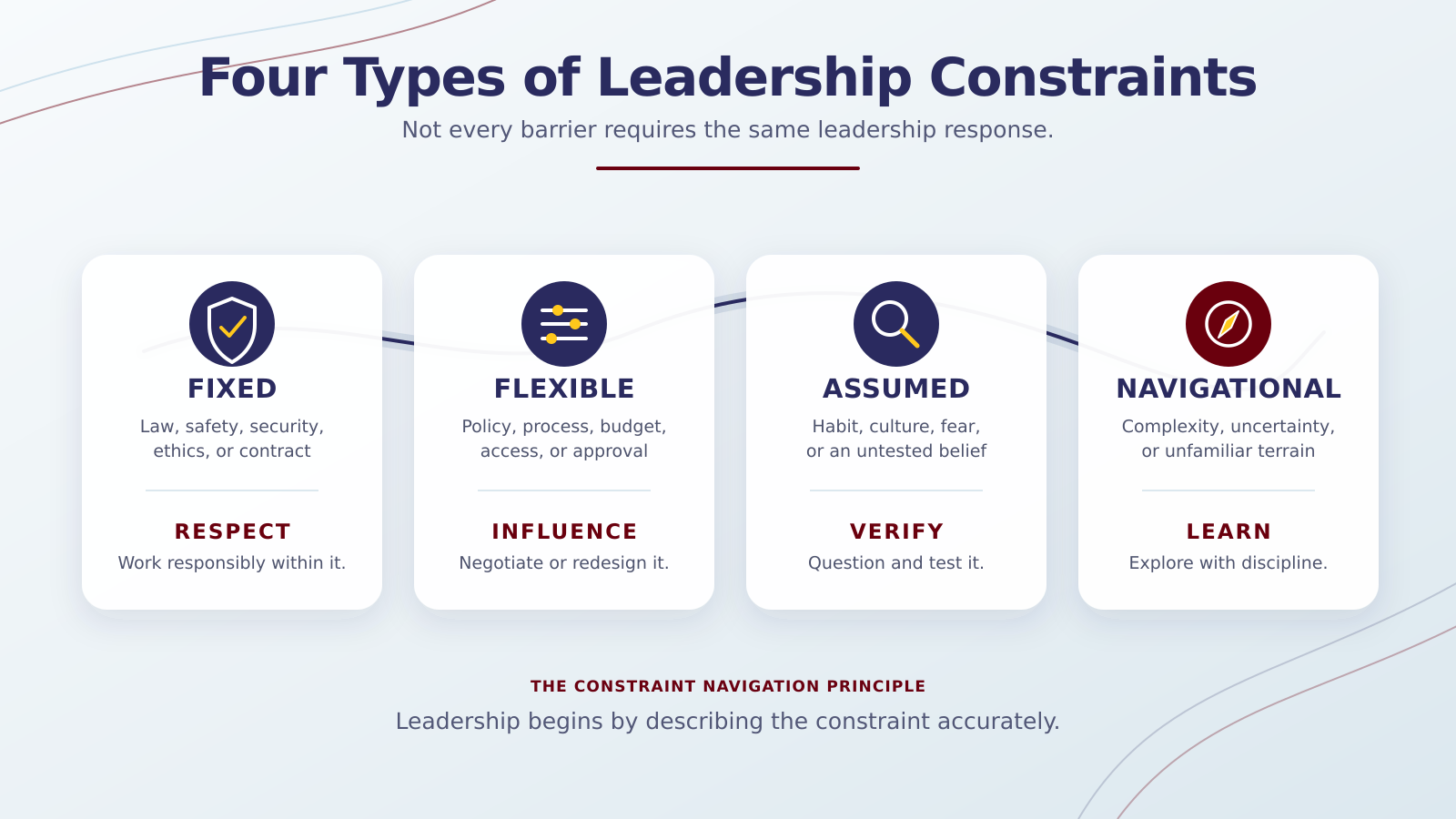
I see four types of leadership constraints. Each requires a different response.
1. Fixed constraints
Fixed constraints include laws, regulations, contracts, security protocols, ethical standards, and genuine limits involving time, money, or safety. Leaders must respect them and avoid creating unnecessary risk for the organization or the people who depend on it.
2. Flexible constraints
Flexible constraints are real but not necessarily permanent. Budgets may be reallocated, processes clarified, policies revised, and resources shared. These constraints call for evidence, influence, and negotiation rather than defiance.
3. Assumed constraints
Assumed constraints are boundaries people accept without verifying them. They sound like “Leadership will never approve this,” “We have always done it this way,” or “Someone in my position cannot propose that.” Because they often originate in limiting beliefs, culture, or an incomplete understanding of policy, they call for verification and better questions.
4. Navigational constraints
Navigational constraints arise when the environment itself is complex, unfamiliar, or rapidly changing. AI is a prime example because leaders face tool overload, uneven guidance, changing capabilities, and uncertainty about what is safe or useful. Navigational constraints call for disciplined learning and measured experimentation.
What Happens When Value Meets a Constraint?
In the previous article, The Visibility vs. Value Principle, I examined the difference between being seen and creating meaningful value. The next test is whether you can continue creating value when authority, resources, access, or certainty are limited.
Leaders who depend on visibility may manufacture activity, speak before they have clarity, or force an initiative before the organization is ready. Others withdraw and treat limited authority as an absence of influence. Both responses place the leader’s discomfort at the center of the decision.
The Constraint Navigation Principle places the mission, the people affected, and the quality of the decision at the center instead. When leaders stop measuring value by visibility, they can examine what is actually limiting progress and choose their next move with greater discipline
Why Is AI a Leadership Constraint in Its Own Right?
AI does not merely operate within constraints. For many leaders, learning how to navigate AI has become a constraint of its own. They are expected to make consequential decisions about technology they may still be learning themselves.
Pew Research Center surveyed 5,273 employed American adults and found that 52 percent felt worried about future AI use in the workplace, while 33 percent felt overwhelmed. Among workers who had used AI chatbots, 40 percent said the tools helped them work more quickly, but only 29 percent said they improved quality. Those findings reveal an important leadership distinction: AI can accelerate activity, but speed is not the same as value.
Some leaders respond by buying tools or announcing initiatives because the organization wants to appear current.
Without a defined purpose, safeguards, training, and human accountability, visible AI adoption may create risk without improving the work. Other leaders avoid AI because the landscape feels complicated or because one restriction is interpreted as a universal prohibition.
Federal guidance demonstrates the need for greater precision. In April 2025, the Office of Management and Budget directed executive agencies to accelerate responsible AI adoption while maintaining safeguards for privacy, civil rights, and civil liberties. The National Institute of Standards and Technology also emphasizes defined business uses, risk assessment, human roles, training, and an understanding of system limitations.
The most useful question is not simply, “Can we use AI?” Leaders should ask what is prohibited, what requires approval, what can be explored safely, and what limitation has merely been assumed. That inquiry is the Constraint Navigation Principle in practice.
Does Constraint Navigation Mean Finding a Way Around the Rules?
No. Constraint navigation is not finding a clever way around a policy, regulation, or safeguard. It does not excuse entering protected information into an unapproved tool or disguising unauthorized activity as innovation.
Strong leaders investigate the purpose of the boundary, the risk it addresses, and the authority governing it. That inquiry may confirm that the boundary is fixed. It may also reveal that the policy is narrower than assumed, an approval path exists, or a limited pilot could allow responsible learning.
What My Own Leadership Experience Taught Me About Constraints
I learned about constraints long before AI entered the workplace. After surviving a plane crash, I spent months in the hospital and years rebuilding my mobility. I used a wheelchair, graduated to crutches, and later a cane, but reaching my office required navigating 17 stairs. At the same time, I was responsible for leading 35 employees on a Department of Energy contract.
Those constraints were not theoretical, and I could not remove them by adopting a more positive attitude. My physical limitations, the stairs, and the responsibilities of the contract were real. The people who relied on my leadership still needed decisions, direction, and consistency.
What I could control was how I interpreted the constraint and where I directed my energy. I had to distinguish between what my circumstances genuinely prevented and what they merely made more difficult. I had to stop measuring leadership by how easily I could move through the environment and focus instead on whether I could continue creating value within it.
That experience changed how I understand leadership.
A limitation may alter the route, pace, support required, or way the work gets done, but it does not automatically determine the value a leader can create.
That distinction became the foundation of how I understand the Constraint Navigation Principle.
I see the same issue in the professionals and executives I advise. A regulation may be real, but their interpretation of its reach may be inaccurate. A reorganization may limit formal authority without eliminating influence, and an unfamiliar AI tool may require learning without requiring them to become a technical expert before they begin.
Leadership judgment begins by describing the constraint accurately. When the description is wrong, the leader may solve the wrong problem or accept an avoidable limitation. When it is accurate, responsible movement becomes easier to identify.
How Can Leaders Navigate Constraints Responsibly?
1. Name the constraint precisely
Avoid broad conclusions such as “policy will not allow it” or “we cannot use AI.” Identify the actual policy, regulation, resource limit, approval requirement, or knowledge gap. Precision prevents one boundary from expanding into a universal prohibition.
2. Understand what the constraint protects
Identify whether the boundary safeguards privacy, security, fairness, public trust, financial integrity, or employee well-being. Understanding its purpose helps preserve the protection while revealing whether another path is available.
3. Classify the constraint
Is it fixed, flexible, assumed, or navigational? The category determines the response. Fixed constraints require compliance. Flexible constraints require influence. Assumed constraints require verification. Navigational constraints require learning.
4. Use the influence you have
You may not have authority to change a rule, approve a tool, or allocate a budget. You may still gather evidence, recommend a pilot, identify an approved alternative, or bring the appropriate stakeholders together.
5. Take the smallest responsible next step
Leaders need enough clarity to take the next responsible step, not complete certainty. With AI, that may mean testing one low-risk use case with non-sensitive information, defining human review, and documenting what the team learns. Preserve human judgment and revisit the decision as policies, tools, risks, and knowledge evolve.
A Leadership Reflection
The Constraint Navigation Principle does not promise leaders a clear path. It asks them to see the path more accurately. Some boundaries must be respected, some can be influenced, and some exist because no one has questioned them recently. Others arise because a leader is being asked to operate in an unfamiliar environment and has not yet learned how to move through it.
AI has made this leadership discipline especially visible. The pressure to keep up is real, but so are the risks of moving without judgment. Leaders who confuse activity with value may adopt AI performatively. Leaders who confuse uncertainty with prohibition may avoid it entirely. Responsible leadership occupies the more demanding space between those reactions.
The purpose of leadership is not to eliminate every constraint. It is to prevent legitimate constraints from becoming imaginary walls.
What constraint are you treating as final that may need to be understood more precisely? Comment and let me know. I would value your perspective.
This is part of an ongoing series on timeless leadership principles. More to come.
Keep Learning
- The Visibility vs. Value Principle: Learn why executive influence is built through sustained contribution, judgment, and value rather than constant visibility.
- The Decision Ownership Principle: Explore why leadership credibility depends on standing behind your decisions before, during, and after the outcome.
- Leadership Identity Separation: Why Leaders Must Separate Self from Circumstance: Learn how separating identity from changing circumstances protects judgment and leadership stability.
- The Leadership Patience Principle: Discover why patience is an active leadership discipline rather than passive waiting.
- Career Strategy Insights: Apply to work with Camille and explore more leadership and career strategy guidance from CC Career Solutions.

Frequently Asked Questions
What is the Constraint Navigation Principle?
The Constraint Navigation Principle is a leadership framework for determining which limitations must be respected, which can be influenced, which should be verified, and which require further learning. It helps leaders find a responsible path forward without ignoring legitimate boundaries or surrendering to untested assumptions.
What are the four types of leadership constraints?
The four types are fixed, flexible, assumed, and navigational constraints. Fixed constraints require respect. Flexible constraints may be influenced or redesigned. Assumed constraints must be verified. Navigational constraints arise from complexity or unfamiliarity and require disciplined learning and measured experimentation.
Does constraint navigation mean challenging every rule?
No. Laws, regulations, security requirements, ethical standards, and contractual obligations may establish legitimate boundaries. Constraint navigation requires leaders to understand what a rule protects, who has authority over it, and whether an approved alternative exists. It does not justify circumventing safeguards or ignoring compliance requirements.
How can leaders navigate AI constraints responsibly?
Leaders should clarify applicable policies, identify a defined business purpose, protect sensitive information, and preserve human review. A responsible first step may involve testing one low-risk use case with non-sensitive information, documenting what the team learns, and consulting the appropriate legal, privacy, security, or technology experts.
How can leaders distinguish a real constraint from a limiting belief?
Begin by identifying the source of the constraint. A law, policy, contract, or documented resource limit is verifiable. A statement such as “leadership will never approve this” may be an assumption. If the source cannot be located, the leader should ask questions, gather evidence, and test the belief before allowing it to control the decision.

She also partners with entrepreneurs and business owners, applying the same Magnetic Positioning™ principles to help them attract the right clients and referrals.
Her services include career marketing: federal and private-sector resumes, LinkedIn profiles, interview and salary negotiation strategy, one-sheets, company pages, outplacement support, and AI implementation.
She publishes Magnetize Your Career, a blog and LinkedIn newsletter for mid-career professionals and executives across federal government, private sector, and military.
Learn more at cccareersolutions.com.
You've got this, and I've got you.
#KeepGoing
- Federal Merit Hiring Essays:Judge Blocks Question 3 - September 17, 2026
- AI in Federal Hiring: What OPM’s New Memo Means for Your Next Application - September 4, 2026
- Hope After a Layoff: Rebuild Your Career With Confidence - August 10, 2026