
Quick answer:
The Visibility vs. Value Principle: What Drives Real Executive Influence
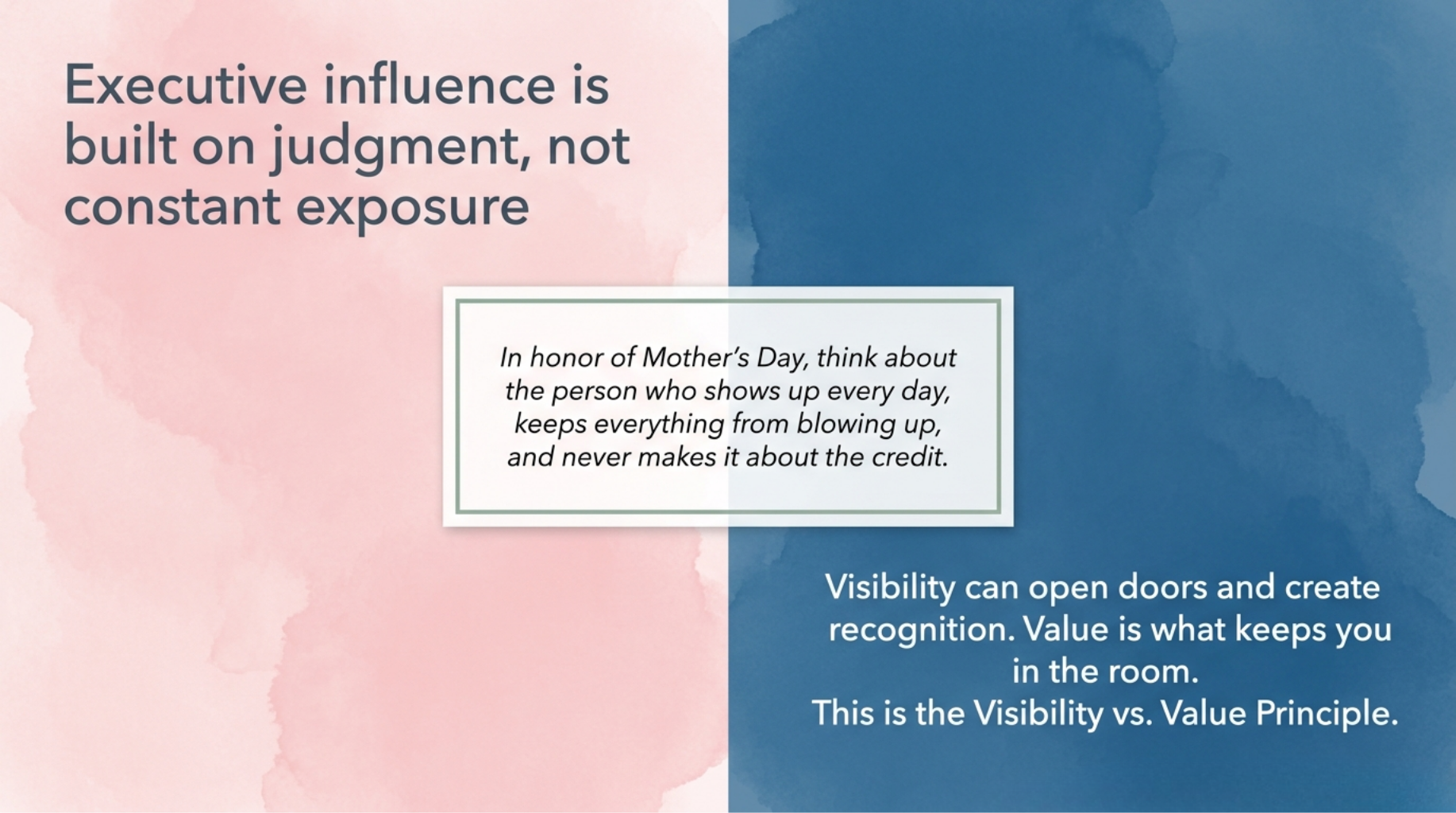
Visibility can open doors and create recognition. Value is what keeps you in the room. At the executive level, the leaders who endure are not necessarily the most visible ones. They are the ones whose judgment improves every decision they touch. This principle explores the difference between being seen and being trusted, and how to position yourself on the right side of that line.
If you’d rather listen to an analogy/adaptation version of the article, click here.
In honor of Mother’s Day weekend, think about the person in your life who shows up every single day, keeps everything from blowing up, and never makes it about the credit. You know exactly who that is. Now ask yourself: is that how your organization would describe you?
Here is the question no one in a leadership role wants to sit with too long: if you disappeared from the calendar for 30 days, would the organization notice because your contribution was missing, or because your presence was?
What happens if you don’t show up?
Those are two very different answers. And the gap between them is exactly what The Visibility vs. Value Principle is designed to close.
This principle builds on the previous one in the series, which explored the importance of taking full ownership of difficult decisions rather than distributing accountability to protect yourself from outcomes.
What Is the Visibility vs. Value Principle?
The Visibility vs. Value Principle recognizes a critical distinction that becomes more important as your career advances: visibility may accelerate recognition, but it cannot substitute for substantive contribution.
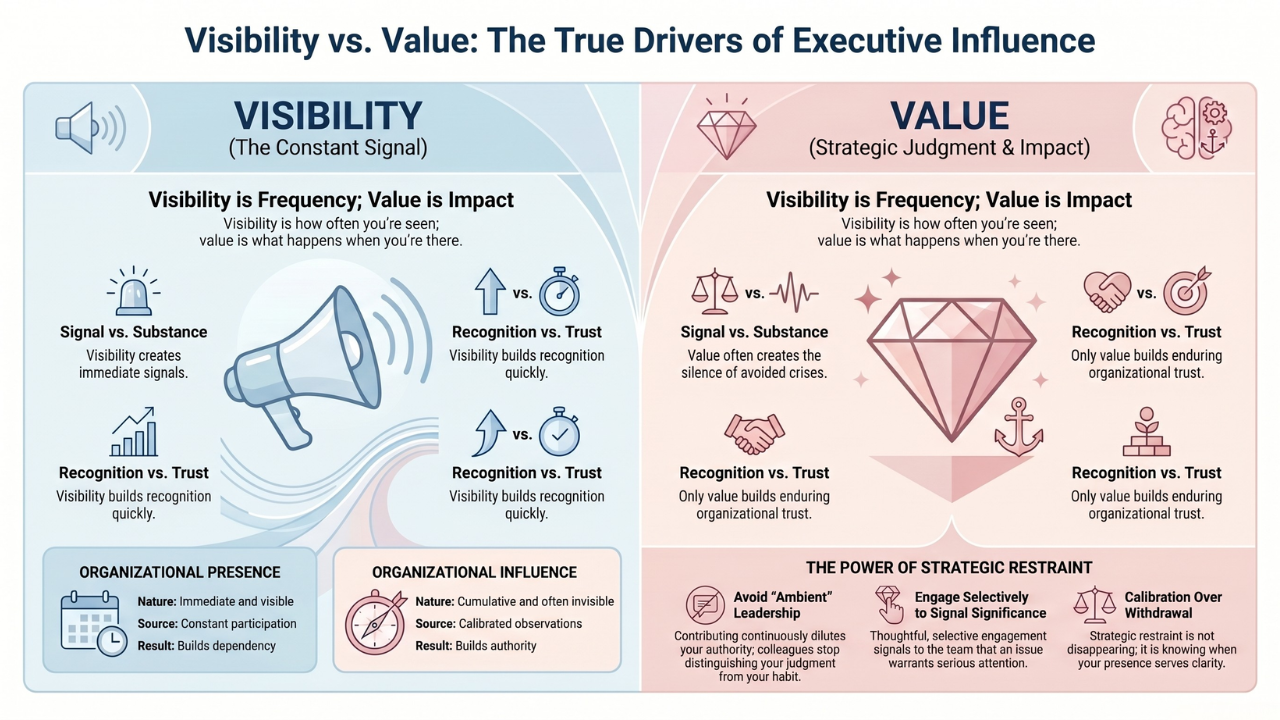
In practical terms, visibility is how often you are seen. Value is what happens when you are there. Early in your career, those two things often move in the same direction. You show up, you contribute, you get noticed. The system rewards the correlation.
At the executive level, the correlation starts to break down. Organizations begin distinguishing between leaders who generate activity and leaders who generate clarity. Those categories are not always the same. Which one you represent will determine the ceiling on your influence.
Why Do Organizations Reward Visibility in the First Place?
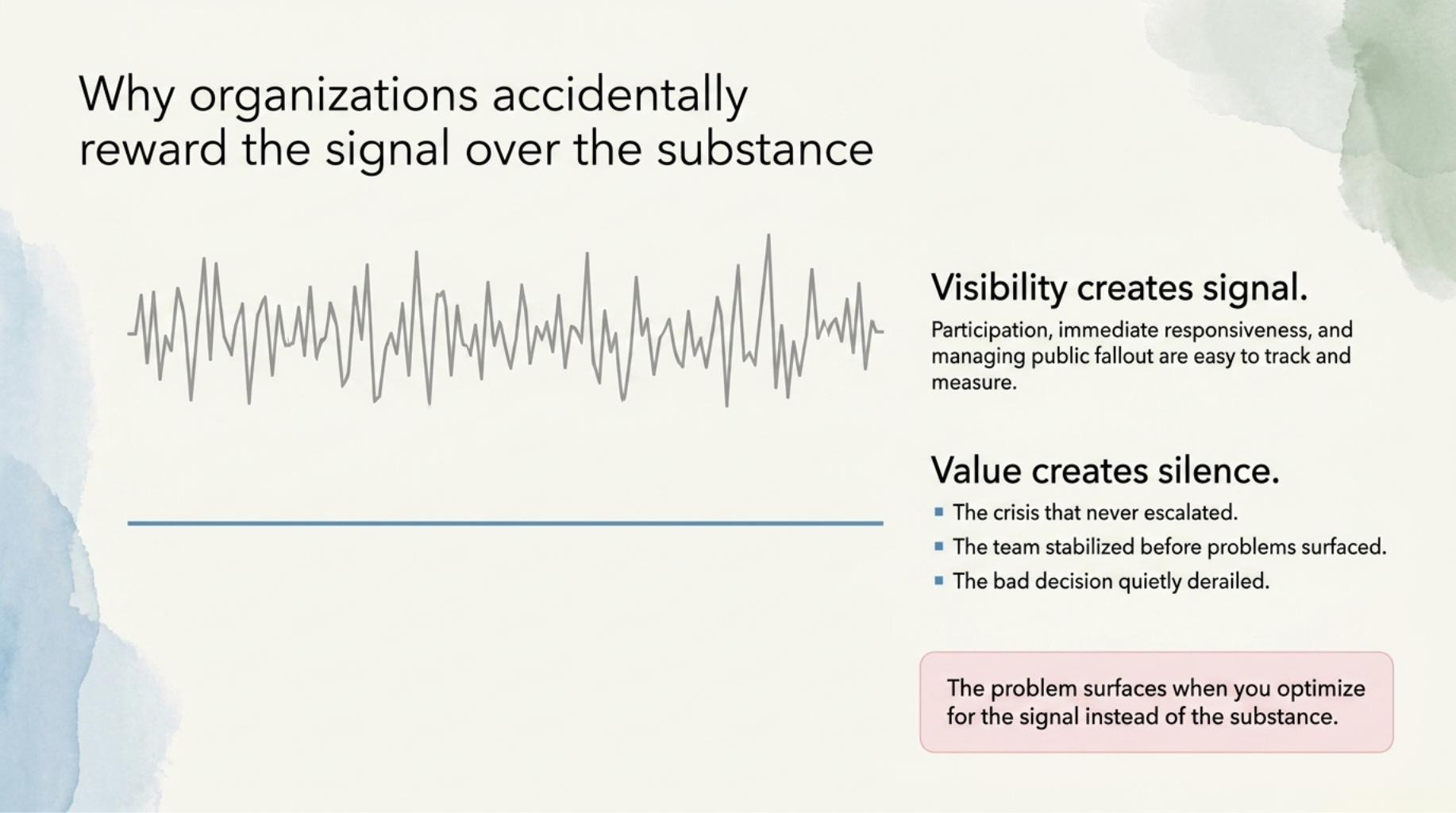
Organizations reward visible activity because it is easy to measure. Participation can be observed. Responsiveness can be tracked. A leader who is constantly present, constantly communicating, and constantly engaged creates immediate, legible signals that colleagues and senior teams can quickly interpret.
Strategic contribution, by contrast, is frequently less obvious in real time. The executive who prevents a crisis from escalating may receive less recognition than the one presenting the recovery plan after it has already happened. The leader who stabilizes a team before problems surface rarely appears as visible as the one managing the fallout publicly.
That is not a flaw in how organizations think. It is just how information travels. Visibility creates a signal. Value often creates silence: the absence of friction, the decision that did not derail, the conversation that never needed to happen.
The problem surfaces when you start optimizing for the signal instead of the substance.
What Is the Difference Between Presence and Influence?
One of the harder realizations for high-performing professionals is that organizational presence and organizational influence are different forms of leadership capital, and the two accumulate differently.
Presence is immediate and externally visible. Influence is cumulative and often invisible while it is still developing. An executive can dominate conversations, maintain high visibility across departments, and remain heavily involved in organizational activity while contributing relatively little strategic clarity. Another leader can speak infrequently but alter the direction of critical decisions through a handful of calibrated observations rooted in pattern recognition and experience.
Senior leadership teams notice that distinction. They may not articulate it directly, but over time, the framing shifts. You become known either as someone whose judgment improves decisions or as someone who needs to be in the room. One of those builds authority. The other builds dependency.
The leaders who sustain influence over decades typically understand this dynamic early. They do not confuse recognition with trust, because they know those forms of professional capital are accumulated through entirely different processes.
An Example from My Work
I worked with an executive who had built a strong reputation inside a large organization through constant participation. He accepted nearly every committee invitation, remained heavily involved across multiple initiatives, and consistently positioned himself as available whenever additional leadership support was needed.
From the outside, his career looked active and upwardly mobile. Internally, a different pattern was forming. Senior leaders viewed him as dependable, but they increasingly associated him with execution support rather than strategic leadership. His visibility had expanded significantly faster than his executive positioning.
During one conversation, he said something I have heard variations of many times since. He told me he no longer knew whether the organization valued his judgment or simply expected his availability. That distinction, once he said it out loud, immediately clarified the deeper issue.
Rather than increasing his exposure further, we focused on narrowing it. He began declining initiatives outside his highest-value areas, communicating with greater precision, and clarifying the specific organizational problems his experience solved exceptionally well. His leadership identity became associated with strategic contribution rather than constant accessibility.
When Less Visibility Produced More Authority
His visibility actually decreased in several areas. What changed was the quality of his positioning. Within months, senior leadership feedback shifted. Executives described him as more focused, more strategic, and more authoritative. His presence became calmer because the need to maintain constant exposure no longer drove it. Alignment between his visibility and his value drove it instead.
Nothing about his intelligence or his work ethic had fundamentally changed. What changed was the relationship between the two.
How Does Strategic Restraint Build Executive Credibility?
Restraint is an underrated executive capability, particularly because earlier career success often rewards the opposite. Responsiveness, availability, and broad participation can absolutely create opportunity at certain career stages. The environment eventually becomes too complex for constant involvement to remain effective.
Executives who attempt to participate in every conversation dilute their authority unintentionally. When you contribute continuously, colleagues stop distinguishing between moments that require your judgment and moments that simply reflect your habit of being present. You become ambient rather than authoritative.
Strategic restraint creates contrast. Leaders who engage selectively and thoughtfully carry greater influence precisely because their involvement signals significance. Your team starts recognizing that when you engage deeply, the issue warrants serious attention. Your credibility strengthens not through scarcity alone, but through the consistent quality of what you bring when you do show up.
This does not mean withdrawing from visibility entirely. Organizational silence can create confusion just as excessive exposure can create fatigue. Teams still need communication, alignment, and direction. Withdrawal is not the goal. Calibration is: knowing when your visibility serves organizational clarity and when it primarily serves your own reassurance.
What Does This Mean for You in a Career Transition?
The Visibility vs. Value Principle shows up with particular intensity during executive job searches and career transitions. You may be tempted to maximize visibility before fully clarifying your differentiation: more content, more networking, more outreach, more presence across every platform at once.
Visibility without positioning rarely produces sustainable executive traction. Organizations are not searching for leaders who are merely visible. They are searching for leaders who reduce uncertainty, improve execution, navigate complexity, and exercise sound judgment under pressure. Those qualities are communicated through evidence, consistency, and strategic clarity, not through volume.
The professionals who appear most grounded during transitions are often the ones least preoccupied with remaining constantly visible. Their attention is directed toward demonstrating differentiated value rather than maintaining continuous exposure. They have done the work of identifying what they solve exceptionally well, and they lead with that consistently.
That kind of positioning is what the Visibility vs. Value Principle ultimately asks you to develop: not as a job search tactic, but as a leadership identity.
The Foundation Beneath Your Professional Presence
Visibility can create recognition quickly. Value develops more gradually because it depends on accumulated evidence and repeated demonstrations of sound judgment over time.
Organizations test every leadership reputation under pressure. Economic instability, restructuring, political complexity, and strategic uncertainty reveal whether a leader built executive credibility on exposure or on substantive contribution. During those periods, the distinction between recognition and trust becomes extremely clear. Recognition may attract initial attention. Trust determines whether influence endures once conditions become difficult.
The Visibility vs. Value Principle ultimately asks you to examine the foundation beneath your professional presence. Visibility itself is not the problem. In many contexts, it is necessary. The deeper question is whether your visibility reflects genuine organizational contribution or compensates for the absence of it.
Because eventually every leader confronts the same question: if visibility disappeared tomorrow, would the value still remain?
I hope your answer is yes. If you are not sure, that is exactly where we start.
In honor of Mother’s Day weekend, think about the person in your life who shows up every single day, keeps everything from blowing up, and never makes it about the credit. You know exactly who that is. That is value. That is the principle. And this weekend, it deserves to be celebrated.
Happy Mother’s Day!
Frequently Asked Questions: The Visibility vs. Value Principle
What is the Visibility vs. Value Principle in executive leadership?
The Visibility vs. Value Principle is the recognition that visibility and value are two distinct forms of professional capital that are accumulated differently. Visibility creates recognition; value builds trust. At the executive level, long-term influence depends far more on the quality of your judgment and strategic contribution than on how frequently you are seen or heard in organizational spaces.
How do I know if I am over-indexed on visibility at work?
A common signal is when you feel compelled to be present in every meeting, respond to every message immediately, or participate in every initiative. Not because your contribution is required, but because absence feels professionally risky. Another signal is when colleagues associate you with availability rather than with a specific area of strategic expertise. If your organization knows you are responsive but cannot clearly articulate what you solve, visibility may be outpacing your value positioning.
Can too much visibility actually hurt your executive career?
Yes, it can. When leaders are constantly visible, colleagues stop distinguishing between moments that genuinely require executive judgment and moments that reflect habit or availability. Over time, this can shift your organizational identity from strategic leader to execution resource. Executives who contribute continuously often dilute their authority unintentionally, because contrast is what creates significance. Strategic restraint, applied well, actually strengthens your influence.
What does strategic restraint look like in practice?
Strategic restraint means declining participation in conversations or initiatives that fall outside your highest-value areas, communicating with precision rather than frequency, and identifying the specific organizational problems your experience solves exceptionally well. It also means resisting the urge to be visible for visibility’s sake, particularly in environments where professional recognition is heavily tied to exposure. The goal is alignment between your presence and your contribution.
How does the Visibility vs. Value Principle apply during a job search?
During a career transition, the temptation is to maximize visibility by increasing content output, networking volume, and platform presence across every channel simultaneously. The more effective approach is to clarify your differentiation first, then lead with evidence of strategic contribution consistently. Organizations at the executive level are not searching for leaders who are merely visible. They are searching for leaders who reduce uncertainty and exercise sound judgment under pressure. Position yourself around that, not around volume.
How is organizational influence different from organizational presence?
Presence is immediate and externally visible. Influence is cumulative and often develops without obvious external signals while it is building. A leader can be highly present: participating broadly, communicating frequently, remaining engaged across multiple initiatives, yet contributing relatively little strategic clarity. Conversely, a leader who engages selectively but consistently improves the quality of decisions made in their presence builds influence that compounds over time. Senior teams notice the difference, even when it is not directly articulated.
What is the connection between executive credibility and restraint?
At senior leadership levels, restraint signals judgment. When you engage selectively and thoughtfully, your involvement itself becomes a signal that something matters. Teams and senior leaders begin recognizing that when you engage deeply, the issue warrants serious attention. This creates a form of credibility that frequent participation cannot produce, because it is rooted in trust rather than familiarity.

She also partners with entrepreneurs and business owners, applying the same Magnetic Positioning™ principles to help them attract the right clients and referrals.
Her services include career marketing: federal and private-sector resumes, LinkedIn profiles, interview and salary negotiation strategy, one-sheets, company pages, outplacement support, and AI implementation.
She publishes Magnetize Your Career, a blog and LinkedIn newsletter for mid-career professionals and executives across federal government, private sector, and military.
Learn more at cccareersolutions.com.
You've got this, and I've got you.
#KeepGoing
- What a $405,000/Annual AI Job and Senior Federal Roles Reveal About Magnetic Positioning™ - October 18, 2026
- OPM AI Adoption and the New Pay Tables: What They Signal for Your Federal Career - October 16, 2026
- 534 Years Later: 5 Career Lessons From Christopher Columbus That Still Matter - October 13, 2026