
Quick answer:
Quick answer: What is the decision ownership principle? The decision ownership principle means leadership credibility is built not only by making decisions, but by standing behind them when outcomes become real. If you want to be trusted with greater authority, you need to show that you can use judgment, carry responsibility, and remain accountable when results are mixed or difficult.
What You’ll Discover
- Why the decision is never where your credibility is actually built
- The one question that changes every difficult leadership conversation
- What ownership language sounds like, and how to use it immediately
If you’d rather listen to an analogy/adaptation version of the article, click here: https://tinyurl.com/2fh8eu7k
The Decision Ownership Principle: Leadership Is Revealed in What You Stand Behind
There comes a point in your leadership path where more analysis will not help you. You can gather input, study the variables, and think through every possible outcome, but eventually you still have to choose. That is where leadership becomes visible. It is not just in how well you think, how well you communicate, or how much experience you have. It is in whether you are willing to stand behind the decisions you make when the outcome is no longer hypothetical.
That is the decision ownership principle. Leadership credibility is not built because every decision works out exactly as planned. It is built because you are willing to fully own the decisions you make before, during, and after the results unfold. If you want to lead at a higher level, this is not optional. It is part of the weight of leadership, and it is one of the clearest signals of executive readiness.
What Is the Decision Ownership Principle in Leadership?
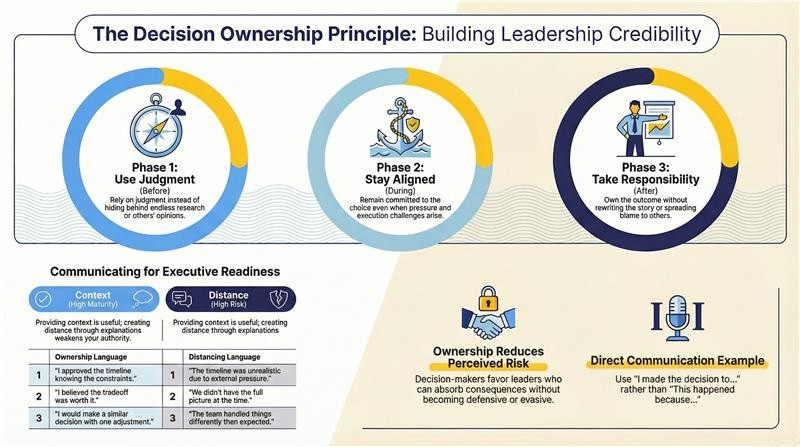
The decision ownership principle means you remain connected to your decisions before, during, and after the outcome. It is not just about making the call. It is about carrying the responsibility that comes with the call.
People often confuse decision ownership with confidence, but they are not the same thing. You can sound confident in the moment and still distance yourself from a decision later. True ownership runs deeper than tone. It shows up across the full arc of the decision.
Before the decision, ownership means you use judgment instead of hiding behind endless research or other people’s opinions. During execution, it means you stay aligned with the choice instead of becoming evasive when pressure rises. After the outcome, it means you take responsibility for what happened without trying to rewrite the story, spread the blame, or detach yourself from the result.
As your level of leadership rises, your decisions carry more consequence. They affect timelines, resources, trust, performance, and sometimes the confidence other people place in the organization itself. Because of that, ownership matters just as much as the quality of the decision. A strong decision with weak ownership can still damage your credibility. A difficult decision with strong ownership can strengthen it.
Why Does Decision Ownership Matter for Leadership Credibility?
Decision ownership matters because people do not only evaluate the quality of your thinking. They also evaluate whether you stay connected to your judgment when the outcome becomes uncomfortable.
The real test usually does not come when you make the decision. It comes later, after the results are known and the pressure to protect yourself increases. That is when the language starts to shift. You may hear someone explain that the picture was incomplete, that circumstances changed, that the team handled things differently than expected, or that the direction came from somewhere above them. Some of those details may be true, but they can also signal something else. They can signal distance.
That distance is what people notice. It is what weakens trust. When someone is evaluating your leadership, whether that is in an interview, a promotion conversation, or an executive search process, they pay close attention to whether you remain connected to your decisions when the outcome gets uncomfortable. Decision-makers ask themselves whether they can trust you with consequential choices and whether you will still be standing there if the result is mixed, messy, or harder than expected.
Leadership credibility is not built by avoiding difficult outcomes. You build it by refusing to step away from your role in them.
How Can You Explain a Decision Without Sounding Defensive?
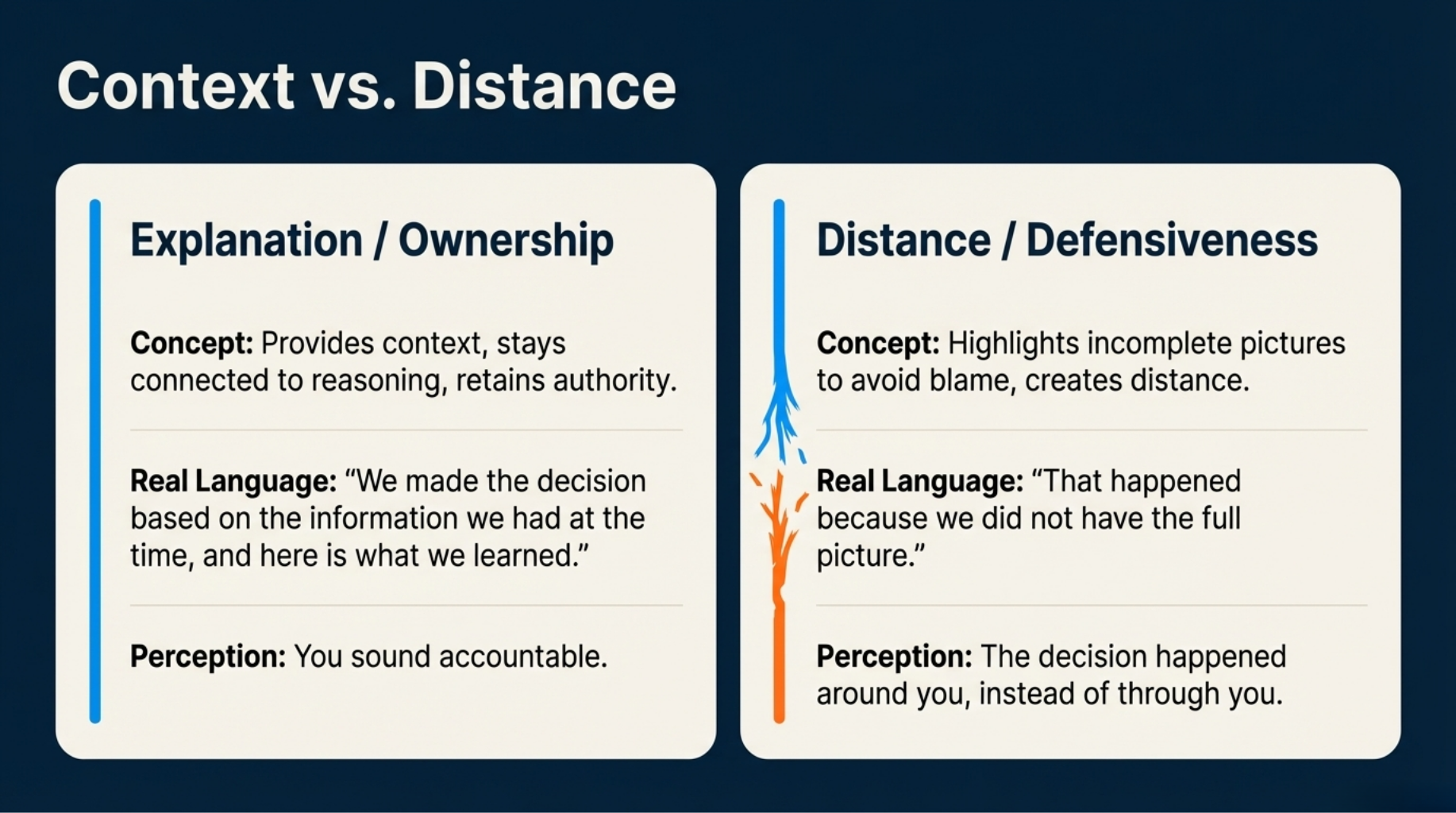
You can explain a decision without sounding defensive by staying connected to your reasoning, your role, and the lessons that followed. Context is useful. Distance is what weakens authority.
There is an important difference between explaining a decision and distancing yourself from it. Feel free to provide context. Talk about constraints, competing priorities, and imperfect information. At senior levels, that context often matters. What matters even more is whether your explanation still reflects ownership.
When you say, “We made the decision based on the information we had at the time, and here is what we learned,” you sound accountable. When you say, “That happened because we did not have the full picture,” you may be telling the truth, but you also risk sounding as though the decision happened around you instead of through you.
That distinction matters because ownership communicates steadiness. It tells people that you understand the burden of leadership and that you can absorb the consequences of a decision without becoming defensive or evasive. That is one reason this principle matters so much in executive positioning. The higher you go, the less people are looking for perfection and the more they are looking for someone who can carry responsibility without flinching.

What Does the Decision Ownership Principle Look Like in Real Life
In real life, the decision ownership principle shows up in how you describe your role in a difficult outcome. The same facts can read very differently depending on how you frame your judgment.
I worked with a senior leader who was preparing for an executive-level role after leading a high-visibility initiative that did not produce the intended outcome. On paper, he had the kind of experience that should have positioned him well. The scope was strong, the work was visible, and the decision-making authority was real. The problem was not the experience itself; it was how he talked about it.
As we walked through the example, he kept describing the result as something shaped by external conditions. He talked about timeline pressure, shifting stakeholders, changing priorities, and limited resources. Every one of those details was legitimate. Still, the overall impression was that the outcome happened around him rather than through his leadership.
The Question That Changed Everything
So I asked him a question that changed the conversation. I asked, “What part of this decision are you willing to stand behind without qualification?”
He paused, then reframed his answer. He said, “I approved the timeline, knowing the constraints. I believed the tradeoff was worth it based on what we were trying to achieve. It did not produce the intended outcome, but I would make a similar decision again with one critical adjustment.”
That shift changed everything. The facts did not change. The ownership did. He sounded like someone with judgment, not someone trying to explain away a hard result. A hiring decision-maker could trust him with greater responsibility because he stayed connected to the decision even when the outcome was not clean.
Why Does the Decision Ownership Principle Matter in Your Career?
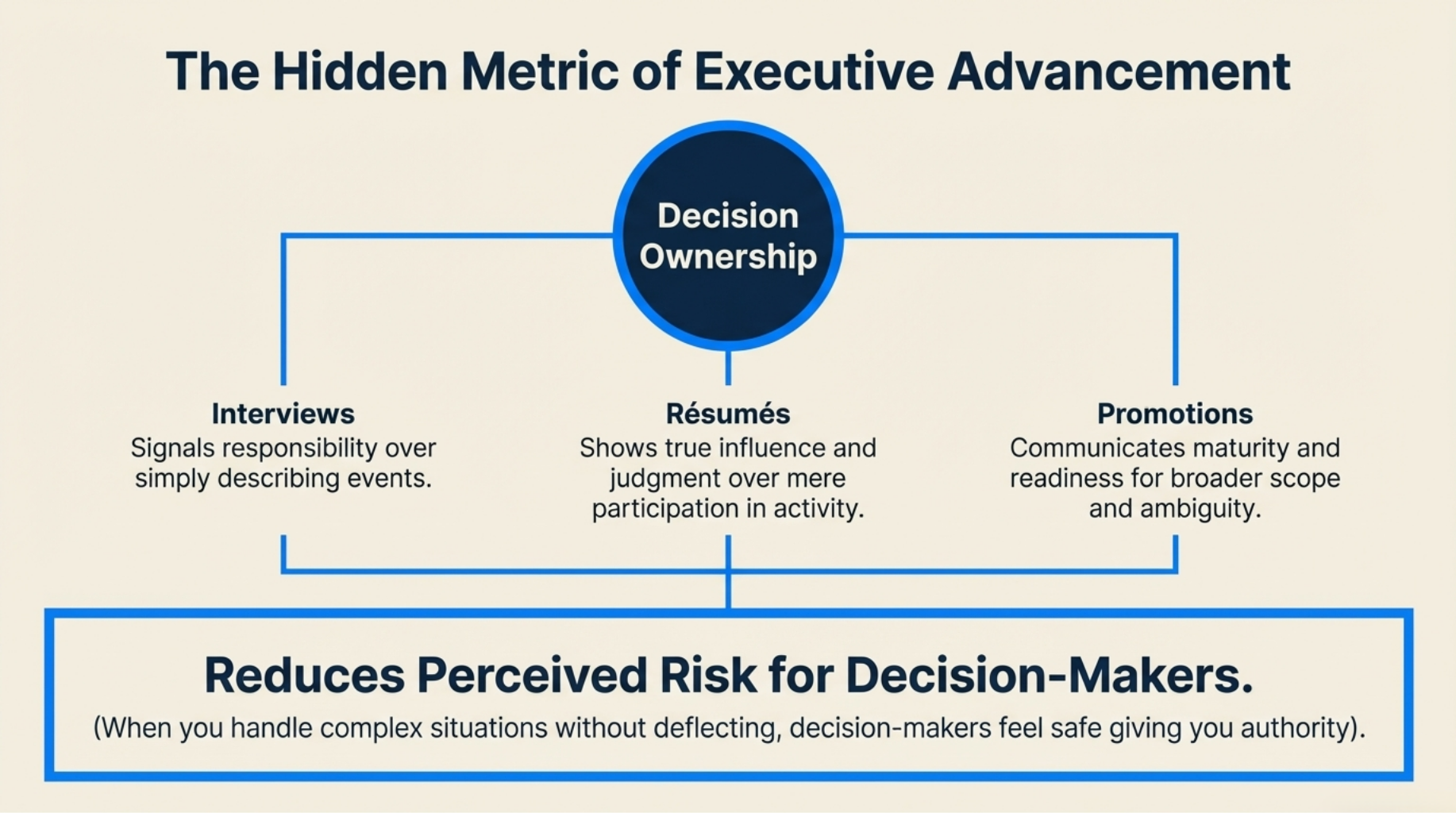
The decision ownership principle matters in your career because it affects how people interpret your readiness for promotion, broader scope, and executive responsibility. Most evaluators look for it even when they never name it directly.
If you are trying to move into a higher-level role, this principle carries more weight than you may realize. Decision ownership is not always named directly, but it is consistently evaluated. It shows up in the way you tell your stories, the way you frame your accomplishments, and the way you discuss moments that did not go exactly according to plan.
Your language in interviews signals whether you take responsibility or simply describe events. On your resume and in leadership narratives, the way you describe decisions shows whether you influenced direction or participated in activity. In performance discussions and promotion conversations, ownership communicates maturity, trustworthiness, and readiness for a broader scope.
What Decision-Makers Are Actually Evaluating
This becomes even more important when decision-makers weigh you for roles that carry higher levels of risk. They are not only asking whether you are capable. Equally important to them is whether they can trust you with greater authority and whether you can handle ambiguity, make sound decisions under pressure, and remain accountable when the situation becomes complex.
If your language suggests that difficult outcomes belong to the environment, the timing, or someone else’s decision, you introduce uncertainty. If your language reflects ownership while still demonstrating learning and adjustment, you reduce that uncertainty. That reduction in perceived risk is often what moves a decision in your favor.
How Do You Apply the Decision Ownership Principle?
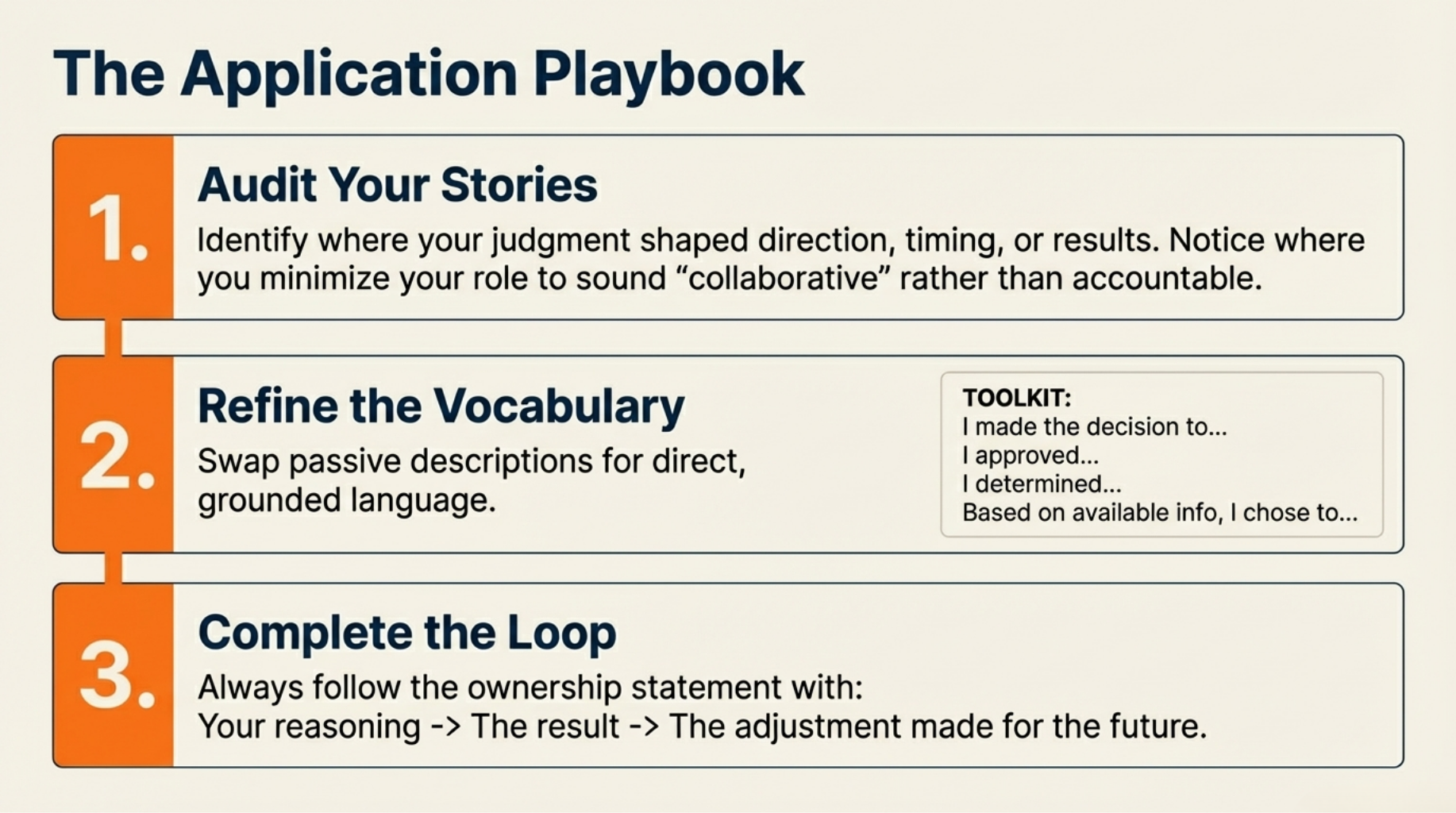
You apply the decision ownership principle by reviewing your career stories, identifying where your judgment shaped the outcome, and refining your language so it reflects responsibility instead of distance.
Start by looking at your own career stories with a more direct lens. Identify the decisions you made that materially influenced an outcome, then assess whether the way you currently talk about those decisions reflects ownership or distance.
Ask yourself where your judgment shaped direction, timing, or results. Notice where you may be minimizing your role because it feels safer to sound collaborative than accountable. Pay attention to how you describe outcomes that were not ideal. Do you sound reflective, or do you move quickly into explanation?
Then refine your language. Strong leadership language is direct and grounded. Use statements such as “I made the decision to,” “I approved,” “I determined,” or “Based on the available information, I chose to.” Follow that with your reasoning, the result, and what you adjusted as a result of that experience.
This is not about overstating your role. It is about representing your responsibility accurately and showing that you understand the weight of your decisions.
What Is the Deeper Risk Behind the Decision Ownership Principle?
The deeper risk is not simply being wrong. It is being wrong and then trying to protect yourself by disconnecting from your role in the decision.
At its core, the decision ownership principle requires you to accept something that leadership inevitably brings: the possibility of being wrong without becoming destabilized. At higher levels, decisions are rarely made with perfect information. You are working with tradeoffs, time constraints, incomplete visibility, and competing priorities.
If you wait for certainty, you delay when leadership is most needed. If you make a decision but later distance yourself from it, you weaken your authority. The discipline is learning how to make a thoughtful decision, carry it with integrity, and remain steady enough to learn from the outcome without shifting into self-protection.
That steadiness is what allows you to continue leading effectively after the decision has been tested.
What Does Decision Ownership Ask of You?
This principle builds on the previous one in the series, which explored the Identity Separation Principle. When your identity is tied too closely to being right or validated, ownership feels risky. You may feel the need to create distance when outcomes are difficult. When your identity is more stable, you do not need to protect yourself in that way. You can remain connected to your decisions, learn from them, and continue leading with credibility intact.
This post connects directly to the principles explored in Leadership Identity Separation: Why Leaders Must Separate Self from Circumstance and The Leadership Patience Principle: Why Enduring Leaders Move Slower Than Everyone Else.
That is why the decision ownership principle matters. It asks whether you are willing to do more than decide. It asks whether you are willing to stand behind what you decided when the pressure increases and the result becomes real.
If you are evaluating your next step, whether that is a promotion, a transition, or a new leadership opportunity, consider this question carefully: Where am I truly leading, and where am I still maintaining distance from responsibility?
If you are ready to strengthen how you position your leadership, your decisions, and your career trajectory, reach out at https://cccareersolutions.com/partner-with-camille.
Leadership accountability and decision-making are foundational concepts in executive development research. For further reading, see the Harvard Business Review’s ongoing coverage of leadership accountability at https://hbr.org/topic/subject/leadership.
The Bottom Line
- Staying connected to a decision after a hard outcome is a choice, not a personality trait.
- The moment pressure increases is the moment leadership is most visible.
- Context explains. Ownership accounts. Only one of those builds trust.
- “What part of this decision are you willing to stand behind without qualification?” is the question that changes everything.
- Reducing perceived risk in the minds of decision-makers is often what moves a placement in your favor.
- The leaders who get selected are not the ones with perfect outcomes. They are the ones who can carry the weight of a real call without flinching.
Frequently Asked Questions (FAQs)
What is the decision ownership principle?
The decision ownership principle is the idea that leadership credibility is built not only by making decisions, but by standing behind them when outcomes become real.
Why is decision ownership important in leadership?
Decision ownership signals maturity, accountability, steadiness, and readiness for greater authority. Most evaluators look for it even when they do not name it directly.
How do you show decision ownership in an interview?
Describe the decision you made, the reasoning behind it, the result, and what you learned. Do not distance yourself from the outcome, even when results were difficult.
What is the difference between explanation and ownership?
Explanation provides context. Ownership keeps you connected to the decision and its consequences instead of sounding defensive or detached.
Can decision ownership help with promotions?
Yes. Decision ownership strengthens promotion readiness because it reduces perceived risk and signals that you can be trusted with broader responsibility.
How do you write about decision ownership on a resume?
Highlight decisions you made, the judgment involved, and the business, mission, or team results that followed. Use active, first-person language.

She also partners with entrepreneurs and business owners, applying the same Magnetic Positioning™ principles to help them attract the right clients and referrals.
Her services include career marketing: federal and private-sector resumes, LinkedIn profiles, interview and salary negotiation strategy, one-sheets, company pages, outplacement support, and AI implementation.
She publishes Magnetize Your Career, a blog and LinkedIn newsletter for mid-career professionals and executives across federal government, private sector, and military.
Learn more at cccareersolutions.com.
You've got this, and I've got you.
#KeepGoing
- US Tech Force: Who It Fits and How to Get Ready - October 7, 2026
- Federal Merit Hiring Essays:Judge Blocks Question 3 - September 17, 2026
- AI in Federal Hiring: What OPM’s New Memo Means for Your Next Application - September 4, 2026