
Quick answer:
Performance has always mattered in your federal career.
You already know that. It shaped your promotions, your step increases, how leadership saw you, how you moved through the ranks. In a reduction in force, though, federal RIF performance ratings were always last in the retention order. That is what changed, and whether you are a GS-9 or a senior executive, your record needs to be ready.
In all my experience working with federal professionals across nearly every agency, from GS-9s to senior executives and appointees, I have never met a serious federal professional who did not understand that performance was part of the game. What most people did not expect was for it to become the deciding factor in a reduction in force.
Listen here to an analogy/adaptation version of the article: https://tinyurl.com/ypb8k39k
The Rule That Changed the Equation
That is what changed.
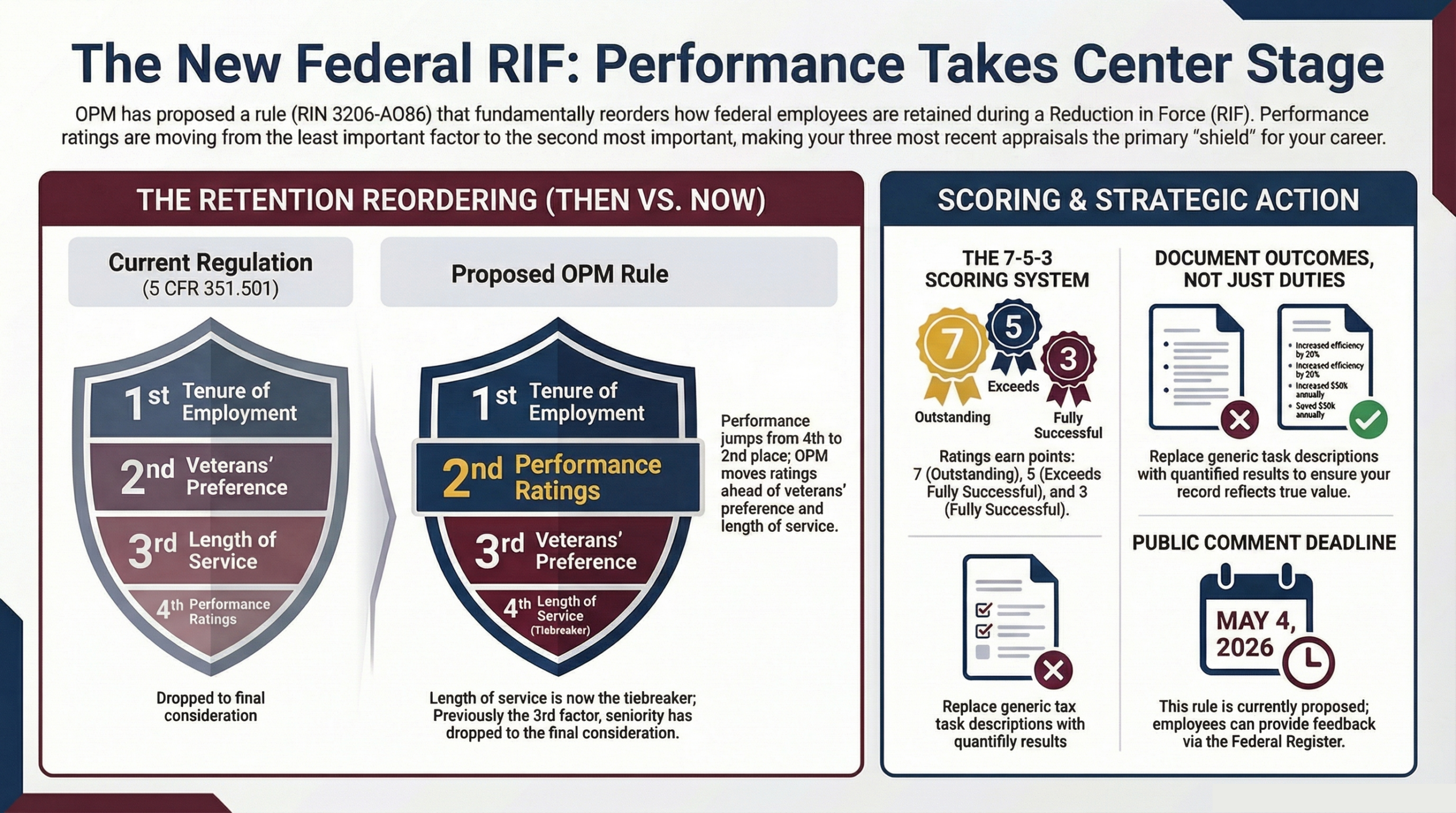
The Office of Personnel Management has proposed a rule that moves performance ratings from the last retention factor in a federal RIF to second in the order, right after tenure group. Seniority does not disappear. Veterans’ preference does not disappear. The structure that determined who stayed and who went in a RIF has been reordered in a way that changes what your record needs to do for you. As a result, your last three appraisals now carry more weight than they ever have.
This post breaks down exactly what changed in the federal RIF performance ratings order, why it matters for where you are right now, and what you can do about it before this rule is finalized. For the full picture of how the federal hiring landscape is shifting right now, read MASSIVE Federal Hiring Shake-Up: What Every Federal Job Seeker Needs to Know Now.
Federal RIF Performance Ratings: The Retention Order Then and Now
To understand what changed, you need to see the before and after side by side.
Under current regulations at 5 CFR 351.501, the retention order for a federal RIF is:
- Tenure of employment
- Veterans’ preference
- Length of service
- Performance ratings (used to add supplemental credit to your service calculation)
Performance was last. It added years of credit to your length of service calculation, which mattered at the margins. The structure above it, tenure group, veterans’ preference, and years of service, did the primary work of determining where you landed on a retention register.
Under OPM’s proposed rule, that order becomes:
- Tenure of employment
- Performance ratings (your three most recent appraisals, scored and ranked)
- Veterans’ preference
- Length of service (now the tiebreaker)
Performance moves from fourth to second. Length of service moves from third to last. Veterans’ preference, which currently sits in second place, drops to third. That is not a minor adjustment. That is a structural reordering of what protects you in a RIF.
The proposed scoring system assigns numerical credit based on your three most recent ratings of record: seven points for an outstanding rating, five for exceeds fully successful, three for fully successful, and zero for lower ratings. Veterans’ preference points augment that score. Ties break by tenure subgroup and then by service computation date.
The rule is still proposed. The public comment period is open through May 4, 2026 at regulations.gov. The direction is clear, and the time to get your record in order is not after a RIF is announced.
What the Federal RIF Performance Ratings Change Means for Your Record
Here is where I want to push you a little, because this is the part most people skip over.
Does your performance record actually reflect what you have done? Or does it reflect how you described what you did?
Those are two very different things. And in all my experience working with federal professionals across nearly every agency, the gap between the two is almost always significant. The work was there. No one ever showed you how.
I have helped GS-9s through senior executives and appointees across intelligence, IT, cybersecurity, law enforcement, medicine, engineering, logistics, aviation, finance, and federal management reframe how they document their contributions. Not fabricate. Not embellish. Document. There is a real and meaningful difference between writing “managed project coordination activities” and writing “led cross-agency coordination for a 14-month initiative that reduced processing delays by 31%.” Both describe the same work. Only one of them tells the story of your value.
Most federal employees underwrite themselves. There is a cultural hesitation in government around what feels like bragging. Documenting your impact is not bragging. It is career strategy. It always has been. Under a performance-first RIF framework, it is also self-protection.
There is one more complication worth understanding. OPM’s own data shows that roughly 64% of federal employees on a five-level rating system received an outstanding or exceeds fully successful rating in fiscal years 2022 through 2024. That level of compression means that under a performance-first system, differentiation may be harder in practice than the rule intends. The employees who are positioned best are the ones whose records are specific, accomplishment-forward, and impossible to compress into a generic rating without losing something real.
The Performance Documentation Gap
Your performance appraisal and your resume need to be telling the same story. Right now, for most federal professionals, they are not. If you are not sure what strong, results-forward career documentation looks like, read What Is a Magnetic Resume? (And Why You Need One to Get Hired Faster!), the same principles apply directly to your performance documentation.
Your resume gets attention when you are job searching. A performance appraisal, on the other hand, gets attention once a year, often rushed, often written in the same generic language it has always been written in. The result is a record that does not reflect your actual contributions, and under a system where that record now determines your retention standing, that gap has real consequences.
Here is what strong performance documentation looks like. It leads with outcomes, names the problem, describes the action taken, and quantifies the result wherever possible. Strategic, accomplishment-forward language makes the contribution visible to someone who was not in the room when the work happened.
When I work with federal professionals through our Get H.I.R.E.D. System™, one of the first things we do is audit the gap between what they actually accomplished and how they described it. The gap is almost always there. Closing it is not complicated once you know what to look for.
What You Can Do Right Now
You do not need to wait for this rule to be finalized to take action. Here is where to start.
- Pull your last three performance appraisals. Read them the way a stranger would, someone who does not know you, has never seen your work, and is deciding in 60 seconds whether your record reflects someone worth keeping.
- Look at the language. Does it lead with outcomes or duties? Does it name the specific result or just the activity? Does it reflect the level of complexity and judgment your work actually requires?
This is the moment to engage with that process differently. Don’t wait for your supervisor to define your contributions. Come to that conversation with your own documentation. Know what you accomplished. Know how to say it. The professionals who do this work consistently are not scrambling when a RIF is announced. They have a record that holds.
If you are not sure how to approach this, that is exactly what I do. Apply to work with me here: Partner with Camille — CC Career Solutions: Get Hired Fast!
The Bottom Line
Performance has always been part of your federal career. That has not changed. What changed is where it sits when a RIF is on the table. It moved from the bottom of the retention order to second place, and your last three appraisals are now the primary record that determines where you land.
Your record has always told a story. The question worth asking right now is whether that story reflects your full value.
You’ve got this, and I’ve got you.
Frequently Asked Questions
What is a federal RIF?
A federal RIF, or reduction in force, is the process federal agencies use to eliminate positions due to reorganization, budget cuts, lack of work, or other workforce changes. The RIF process follows a specific retention order that determines which employees keep their jobs and which are separated, furloughed, or reassigned.
What is the federal RIF retention order?
The federal RIF retention order determines which employees are retained when positions are cut. Under the current rules, the order is: (1) tenure group, (2) veterans’ preference, (3) length of service, and (4) performance ratings. OPM has proposed moving performance ratings to second in this order, ahead of veterans’ preference and length of service.
How do performance ratings affect a federal RIF?
Under OPM’s proposed rule, your last three annual performance appraisals determine your position in the retention order during a federal RIF. Employees with higher documented performance ratings would be retained ahead of lower-rated employees within the same tenure group, even if they have fewer years of service.
What are the four RIF retention factors for federal employees?
The four retention factors in a federal RIF are tenure group, veterans’ preference, length of service, and performance ratings. OPM’s proposed rule would reorder these to: (1) tenure group, (2) performance ratings, (3) veterans’ preference, and (4) length of service.
What should federal employees do to protect themselves in a RIF?
Federal employees should audit their last three performance appraisals to confirm they accurately reflect the scope and impact of their work, document accomplishments in writing before each rating period closes, and address documentation gaps with their supervisor before a RIF is announced. Proactive performance documentation is the most actionable step available right now.
Is the OPM RIF performance ratings rule final?
No. As of this writing, OPM’s proposed rule moving performance ratings to second in the federal RIF retention order is in a public comment period open through May 4, 2026. The rule has not been finalized. Federal employees and agencies can submit comments at regulations.gov, docket OPM-2025-0004.

She also partners with entrepreneurs and business owners, applying the same Magnetic Positioning™ principles to help them attract the right clients and referrals.
Her services include career marketing: federal and private-sector resumes, LinkedIn profiles, interview and salary negotiation strategy, one-sheets, company pages, outplacement support, and AI implementation.
She publishes Magnetize Your Career, a blog and LinkedIn newsletter for mid-career professionals and executives across federal government, private sector, and military.
Learn more at cccareersolutions.com.
You've got this, and I've got you.
#KeepGoing
- US Tech Force: Who It Fits and How to Get Ready - October 7, 2026
- Federal Merit Hiring Essays:Judge Blocks Question 3 - September 17, 2026
- AI in Federal Hiring: What OPM’s New Memo Means for Your Next Application - September 4, 2026