

Quick answer:
A career strategy that works is not about applying to more jobs. It is about deciding whether a role is worth your time before you apply, presenting your experience in a way that shows the impact you delivered, and shaping how your value is understood. Traction comes from intentional preparation, not volume.
What You’ll Discover
- Why sending more applications often makes results worse, not better
- The one question to answer before you touch your resume or hit submit
- How to shape the way a hiring manager sees your value before they ever meet you
What if the thing holding your search back is not your qualifications?
May 4th brings a moment of lightness most years. “May the Force be with you” is one of those phrases people say and mean it, even when they are smiling. There is something worth borrowing from it, though, not the mysticism but the idea of alignment.
In the Star Wars universe, the Force is not something you force. You align with it. You prepare, you practice, and you show up ready. Your career strategy works the same way.
If you have been staying in motion, sending applications, making updates, and doing everything you think you are supposed to do, and still not seeing the response you expected, the problem is rarely your qualifications. It is almost always the strategy behind the application.
Here is what I have seen working with federal and executive professionals: the people who get traction are not always the most credentialed. They are the ones who approach their search with intention. They decide before they apply. They are selective. They present their experience in a way that makes it easy for someone else to see exactly what they bring.
That is the difference between a career strategy that works and one that just keeps you busy.
Is Your Resume Doing the Work It Needs to Do?
A resume that works in 2026 is not a list of job duties. It is a document that makes your impact impossible to miss.
If your resume reads like a position description, you are asking the hiring manager to do a job that is yours to do: connecting your experience to the value you delivered. They will not. They will move to the next candidate.
The shift is from responsible for to delivered, created, reduced, increased, and led. It is the difference between “Managed a team of analysts” and “Led a 12-person analytical team through a 90-day restructure that reduced reporting time by 40%.” One tells the reader what the job was. The other tells them what you are worth.
The STCARI Story Method is the framework I use with every client to pull out the real story behind each role: the Situation, the Task, the Complication, the Action, the Result, and the Impact. When you write your experience through that lens, your resume stops being a history and starts being evidence.
Need help finding the right language for your experience? What Is A Magnetic Resume? (And Why You Need One To Get Hired Faster!) walks through the process in detail.
Are You Shaping How Your Value Is Understood?
This is the question most people never ask, and it is the one that changes everything.
Your value does not speak for itself. You have to shape it. That means deciding, before you apply, what story you want this application to tell. Which accomplishments are most relevant to this specific role? Which experiences need to be front and center? What does this hiring manager need to understand about you that your job titles alone will not communicate?
This is not spin. This is a strategy. The professionals who get called back are not always the most qualified. They are the ones who made it easy for a hiring manager to see exactly what they bring and why it matters for this specific role. In 30 years of working with federal and executive professionals, that is the pattern I see consistently. Tailoring is not optional. It is the work.
When you shape how your value is understood, you are not changing who you are. You are making it easier for someone else to see why you are the right person for this specific role. That is what a career strategy that works actually looks like.
What Does a Career Strategy That Works Actually Look Like?
It is specific. It is deliberate. It operates before the application is ever submitted.
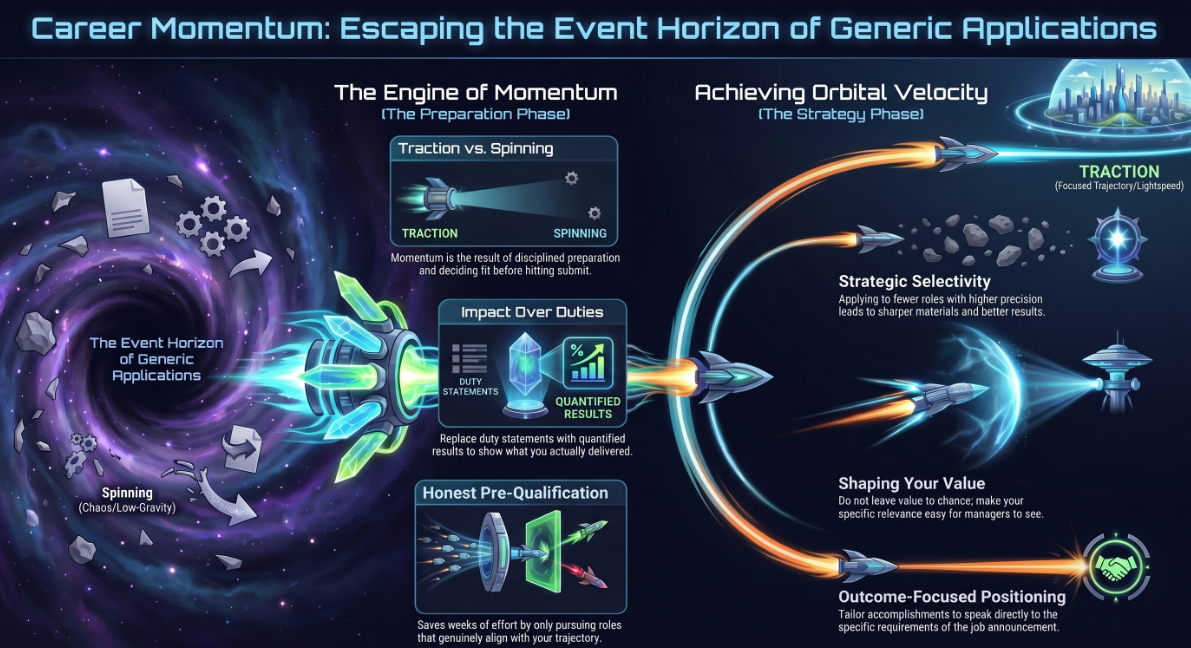
A career strategy that works means you have evaluated the role honestly before investing your time. It means your resume is written around the impact you delivered, not the duties you held. It means your LinkedIn profile positions you for where you are going, not just where you have been. It means you know what you bring, you can articulate it clearly, and you have made it easy for the people reviewing your materials to see it.
It also means you are not applying to everything. Volume is not momentum. Volume is noise. Momentum is what happens when the right application, written with intention, reaches the right decision-maker at the right time.
The professionals who move quickly when the right opportunity appears are not lucky. They are prepared. Their strategy is already in place. When the opportunity opens, they are ready to step into it.
If you are ready to approach your next move with a career strategy that actually works, I can help. Reach out at https://cccareersolutions.com/partner-with-camille and let’s talk about what that looks like for your specific situation.
The Bottom Line
A career strategy that works starts before you ever open a job announcement.
Volume of applications is not momentum. Intention is.
Your resume is not a history of your duties. It is evidence of the impact you delivered.
Your value does not speak for itself. You have to shape how it is understood.
The professionals who get traction are not always the most credentialed. They are the most prepared.
Selectivity, clarity, and intentional positioning are the difference between a search that stalls and one that moves.
#MayTheForceAndStrategyAlwaysBeWithYou
If you’re interested in being among the first to use our Qual-Fit Role Assessment™, DM me or comment, and I’ll be sure you get access. We are putting the finishing touches on it now.
Are You Applying With a Strategy, or Just Applying?
The honest answer to that question determines most of what happens next in your search.
A career strategy that works starts before you open the job announcement. It starts with an honest look at whether this opportunity is actually a match for where you are in your career and what you bring to the table. That is not the same as asking whether the job looks interesting or whether you meet the minimum qualifications on paper.
Soon, I will be debuting an update that addresses this directly: the Qual-Fit Role Assessment™. It is a structured framework that I’ve used to walk clients through before they invest time in any application. It evaluates fit across your specialized experience, qualifications, and career trajectory. It gives you a clear, honest read on whether this role is worth your full effort before you write a single word of your application.
Most people skip this step entirely. They see a title that sounds right, and they apply. Then they wonder why they are not hearing back.
Selectivity is a strategy. When you apply only to roles where you have a genuine, specific case to make, your materials improve, your focus sharpens, and your results follow.
Frequently Asked Questions:
What is a career strategy that works for federal job seekers?
A career strategy that works for federal job seekers starts with honest pre-qualification before any application. It means evaluating whether your specialized experience, qualifications, and career trajectory genuinely align with what the position requires. From there, it means writing a resume that demonstrates impact rather than listing duties, and tailoring your materials to the specific role rather than using a generic version of your documents.
How do I know if I am applying to the right Qual-Fit Role Assessment™?
Before you apply, run an honest assessment of the fit. Look at the specialized experience requirements, not just the general qualifications. Ask whether your background gives you a specific, defensible case to make for this role. If the answer is yes, the application is worth your full effort. If there are gaps, understand them before you proceed. The Job Application Filter™ is the framework I use to walk clients through this exact evaluation.
Why am I applying to jobs and not getting called back?
In most cases, it is not the qualifications. It is the presentation. A resume that lists duties without quantifying impact makes it hard for a hiring manager to see what you actually delivered. A generic application that does not connect your experience to the specific requirements of the role asks the reader to do work that is yours to do. They will not. Shaping how your value is understood, clearly and specifically, is what changes the response rate.
How do I write a resume that shows impact instead of duties?
Start by replacing every duty-based statement with a result. Instead of “Managed a team,” ask: what did that team accomplish under your leadership, by how much, and in what timeframe? The STCARI Story Method (Situation, Task, Complication, Action, Result, Impact) gives you a structure for pulling out the real story behind each role. When every bullet on your resume answers the question “what did you deliver,” the document becomes evidence rather than history.
What is the difference between momentum and applying to a lot of jobs?
Momentum is what happens when the right application, written with intention and tailored to a specific role, reaches the right decision-maker. Applying to a high volume of roles without evaluating fit or tailoring your materials is activity, not strategy. It produces noise, not results. The professionals who move quickly in their search are usually the ones who apply to fewer roles with more precision and preparation behind each one.
How does LinkedIn fit into a career strategy that works?
Your LinkedIn profile is doing active work whether you are paying attention to it or not. Recruiters, hiring managers, and agency HR professionals search LinkedIn daily. If your profile is outdated, generic, or positioned around where you have been rather than where you are going, it is costing you opportunities. A profile that positions you for your target role, with a headline that reflects your value and an About section that speaks to what you bring, is a core part of any career strategy that works.

I work with mid-career professionals and executives across the federal and private sectors when the stakes are high and the next move matters.
My work focuses on helping leaders make smart career decisions, clarify their leadership narrative, and navigate complex hiring environments with intention and perspective. I partner with clients at moments of transition, promotion, or repositioning, when experience is strong but the path forward requires judgment rather than generic advice.
With more than 25 years of experience advising professionals and senior leaders across nearly every federal agency, as well as Fortune 500 and global organizations, I bring a systems-based approach to career strategy. Rather than treating résumés, interviews, and career decisions as isolated tasks, I help clients build a coherent, future-focused approach to career management that blends human judgment with modern intelligence systems.
Clients work with me when they want clarity, strategy, and intelligent guidance for their best next move.
I would love to meet you and help you Get HIRED in your next role. Thank you for stopping by!
- Support Your Career Journey This Fourth of July - July 4, 2026
- Eric Church, Commencement, and You - May 23, 2026
- The Visibility vs. Value Principle - May 9, 2026