

Quick Answer — Winter Olympic Games Lessons: The Winter Olympic Games reveal that elite performance is rarely about talentalone. They show that experience compounds, preparation must align with execution, and humanity remains visible even in the highest-pressure environments. In careers, the same principles apply: seasoned judgment matters, strategic alignment creates momentum, and leadership is measured not only by results, but by how people show up for others.
Among the many Winter Olympic Games lessons this year, two Olympic moments stayed with me, and neither had anything to do with medals.
The Winter Olympic Games delivered extraordinary performances. Who does not love Alysa Liu? She is pure joy to watch. Jordan Stoltz, Alex Ferreira, Mikaela Shiffrin, and so many others demonstrated what elite preparation truly looks like. Events like these remind us of what years of discipline, resilience, and focus can produce when the stakes are highest.
Yet as the Games concluded, I found myself thinking less about medal counts and more about what lingered afterward. The moments that stayed with me revealed something deeper about capability, experience, and humanity.
What I Found Myself Reflecting On After the Winter Olympic Games
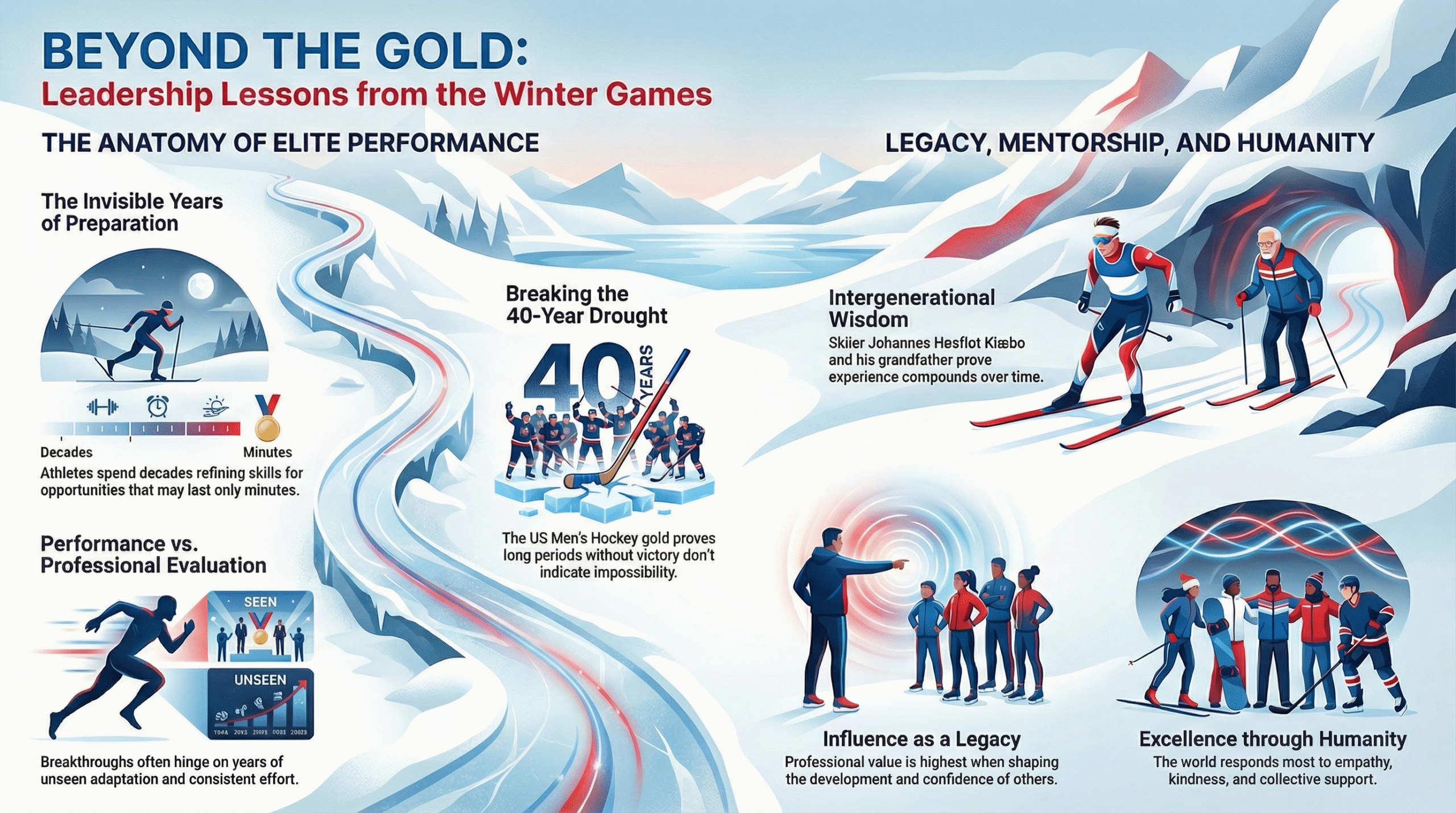
Global events like the Winter Olympics offer more than entertainment. They place preparation, pressure, and performance on full display. We witness years of discipline compressed into moments that may last only minutes.
What continues to fascinate me are the lessons that extend beyond sport and into patterns that feel strikingly familiar in our careers and professional lives.
The 2026 Winter Olympic Games are a powerful reminder that sustained performance requires strategy, not just effort. The same is true in careers. If you are ready to strengthen your positioning, explore how a magnetic résumé and an optimized LinkedIn profile can work together to move your career forward.

An Olympic Champion and his 83-Year-Old Coach!
One of the most compelling stories for me involved Johannes Høsflot Klæbo, the Norwegian cross-country skiing champion often referred to as King Klæbo. His achievements are extraordinary by any measure, yet the detail that captured my attention most was his grandfather and coach, Kåre Høsflot, at 83 years old. If you have not seen NBC’s feature on this grandfather and grandson coaching duo, I genuinely recommend taking a few minutes to watch it.
Experience does not expire. In many cases, it compounds, sharpens, and becomes the invisible advantage behind exceptional performance.
What struck me was not simply the success of an Olympic champion, but what this relationship represents.
What This Story Reveals About Experience, Capability, and Career Value
For anyone who has quietly wondered whether time has reduced their relevance, this story offers a powerful correction.
Recently, I spoke with a 50-year-old professional who believed she might be too old to change jobs. She assumed employers would overlook her, despite the fact that her background reflected exactly the kind of stability, judgment, and perspective many organizations claim they want.
That disconnect appears often in career conversations. Professionals with meaningful experience sometimes underestimate their own market value, especially when cultural messaging overemphasizes speed, novelty, or youth.
But experience does not expire. It compounds.
Over time, judgment becomes sharper. Pattern recognition becomes faster. Decision making becomes more grounded. Perspective widens. In many roles, these are not secondary traits. They are performance multipliers.
That is what made the story of Johannes Høsflot Klæbo and his 83-year-old coach so compelling. It was not simply a story about athletic success. It was a visible reminder that wisdom, refinement, and accumulated insight still shape elite outcomes.
In careers, the same principle applies. Experience, when positioned clearly, becomes a differentiator rather than a liability.
A Moment of Humanity That Carried More Weight Than Competition
Among all the performances and victories, one moment stayed with me that had nothing to do with rankings or medals.
During the men’s hockey celebration, U.S. players Zach Werenski and Dylan Larkin brought two young children onto the ice to honor their late father, Johnny Gaudreau. The camera cut to Johnny’s parents and the children’s mother. The gesture was powerful on its own. Then the players held the children, drawing them into the celebration rather than leaving them as observers.
When I heard the full story, the emotional weight of that moment deepened. Johnny Gaudreau, known to many as “Johnny Hockey,” and his brother Matthew Gaudreau had been killed by a drunk driver. What unfolded on the ice was far more than a tribute. It was an expression of teamwork, compassion, unity, and shared humanity.
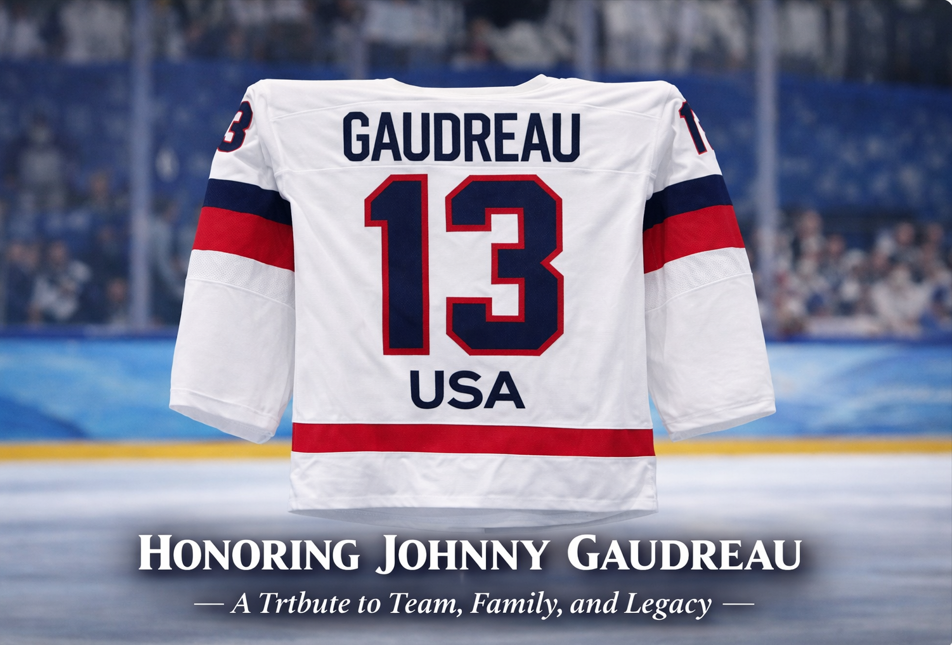
The players held up Johnny’s jersey and embraced the children in a scene that resonated far beyond sport. I was sobbing when I understood the meaning behind it. That moment was not about victory. It was a reminder of what connection, empathy, and respect look like when they are expressed without hesitation, but with humanity and kindness. More of what the world needs.
In an environment defined by pressure and rivalry, the gesture carried extraordinary significance. It revealed something profoundly important: strength and compassion are not opposing forces. At the highest levels of performance, humanity is not diminished. It becomes more visible.
What the Winter Olympic Games Reveal About Careers and Performance
The Winter Olympic Games do more than showcase talent. They make invisible systems visible.
What we see in competition is only the final expression of something much larger: preparation, coaching, recovery, strategy, timing, and execution working together in alignment.
Careers operate under similar conditions.
When professionals feel stalled, the issue is often not capability. More often, the underlying system is fragmented. Experience may be strong, but poorly framed. A résumé may list responsibilities without conveying value. LinkedIn may not reflect leadership readiness. Career decisions may not align with actual priorities, market conditions, or long-term goals.
Effort alone does not solve structural misalignment.
When experience, positioning, and strategy reinforce one another, progress becomes more deliberate. Confidence becomes more stable. Momentum becomes easier to sustain.
That is why career advancement is rarely accidental. Like elite performance, it is built through alignment.
Questions Worth Pondering
Which moments stayed with you during the Winter Olympic Games?
What lessons or observations resonated beyond the events themselves?
And perhaps more importantly, what kind of legacy do you hope your own career will ultimately reflect?
I would genuinely love to read your reflections.
Frequently Asked Questions: Winter Olympic Games Career Lessons
What career lessons can we learn from the Winter Olympic Games?
The Winter Olympic Games reveal two career lessons that extend far beyond sport. First, experience compounds over time rather than diminishing. The story of 83-year-old Kåre Høsflot coaching his grandson to Olympic gold is a powerful illustration of how accumulated wisdom becomes a decisive advantage. Second, elite performance is never accidental. The performances we witness are the outcome of years of deliberate alignment between preparation, positioning, and execution. That same principle applies directly to career strategy.
Does professional experience lose value as you get older?
No, and the belief that it does is more cultural than factual. Experience deepens judgment. Pattern recognition strengthens decision-making. Perspective expands in ways that directly benefit organizations navigating complexity and change. There are leaders and organizations that actively seek stability, maturity, and seasoned insight. The challenge is rarely capability. It is how clearly that experience is positioned and communicated in résumés, interviews, and professional profiles.
What does career alignment actually mean in practice?
Career alignment means that your experience, résumé, LinkedIn presence, and job search strategy all reinforce the same direction. When these elements work together, momentum builds and progress becomes intentional. When they are misaligned, even strong candidates stall. Résumés that do not reflect the intended direction, LinkedIn profiles that do not signal decision-maker confidence, and strategies that do not reflect actual hiring dynamics all create friction that has nothing to do with capability.
How do I know if my career strategy is aligned?
A quick diagnostic: Does your résumé communicate the value you would bring to your next role, or does it describe the duties of your last one? Does your LinkedIn profile position you for where you want to go, or where you have been? Does your career strategy reflect current hiring realities in your field? If the answer to any of those is unclear, misalignment is likely the issue rather than experience or qualifications.
What is the connection between Olympic preparation and job searching?
Elite Olympic competitors do not rely on effort alone. Long before competition, they align preparation, positioning, and execution as an integrated system. Career strategy works the same way. Effort without alignment produces exhaustion rather than results. The professionals who combine strong experience with clear positioning and a strategy that reflects market realities are the ones who move forward consistently, regardless of how competitive the field is.
Why is career positioning important for mid-career and senior professionals?
Mid-career and senior professionals often have the strongest experience in the room. The challenge is translating that experience into language that communicates value clearly to hiring managers, HR specialists, and automated systems. Many experienced professionals underestimate the strength of what they bring because they are too close to it. Strategic positioning, through résumés, LinkedIn, and interview preparation, is what makes that experience visible and competitive.
She also partners with entrepreneurs and business owners, applying the same Magnetic Positioning™ principles to help them attract the right clients and referrals.
Her services include career marketing: federal and private-sector resumes, LinkedIn profiles, interview and salary negotiation strategy, one-sheets, company pages, outplacement support, and AI implementation.
She publishes Magnetize Your Career, a blog and LinkedIn newsletter for mid-career professionals and executives across federal government, private sector, and military.
Learn more at cccareersolutions.com.
You've got this, and I've got you.
#KeepGoing
- What a $405,000/Annual AI Job and Senior Federal Roles Reveal About Magnetic Positioning™ - October 18, 2026
- OPM AI Adoption and the New Pay Tables: What They Signal for Your Federal Career - October 16, 2026
- 534 Years Later: 5 Career Lessons From Christopher Columbus That Still Matter - October 13, 2026