
Senior leaders are often taught that speed signals competence. Decide faster, act sooner, and move before others do. In many professional environments, visible momentum is still mistaken for effectiveness and confidence.
Yet when you study leaders who endure, those who remain trusted, relevant, and steady over decades, a different pattern consistently emerges. Their advantage is not speed, visibility, or constant motion. It is patience exercised with intention and discipline.
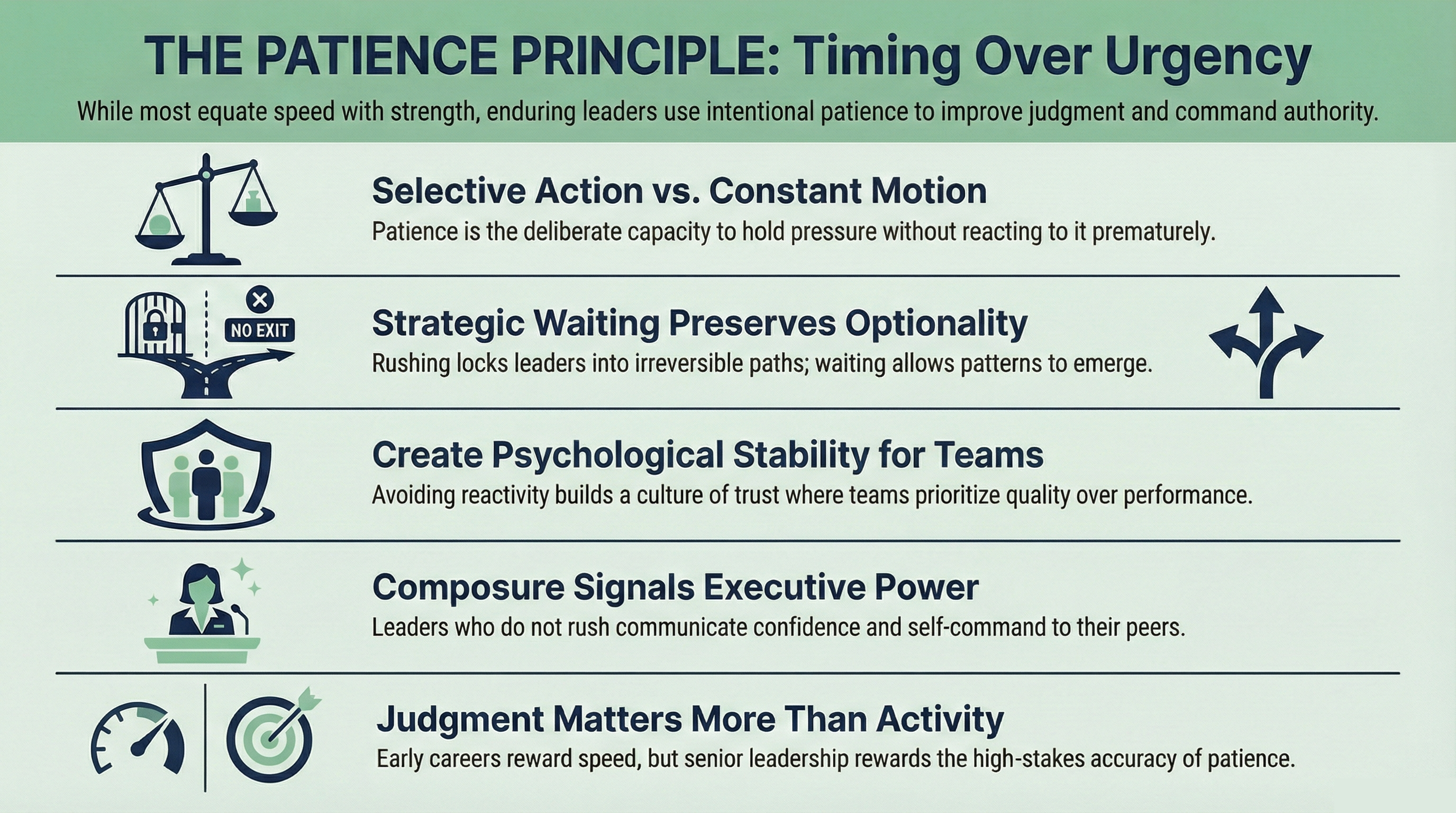
This is not passive patience or waiting without purpose. It is a deliberate capacity to hold pressure without reacting to it. I have learned over time that the leaders who endure are not slower thinkers. They are more selective actors.
The leadership patience principle is the disciplined ability to delay action without losing momentum, to absorb uncertainty without rushing to resolution, and to choose timing as deliberately as direction. It is one of the least visible leadership skills, yet one of the most consequential. In high-stakes environments, patience is not a personality trait. It is a practiced leadership discipline.
Why the Leadership Patience Principle Is Often Misunderstood
Patience is frequently misinterpreted as hesitation or indecision, particularly in executive contexts. When expectations are high and outcomes are scrutinized, leaders often assume that waiting will be read as weakness. As a result, restraint is undervalued.
Many leaders feel compelled to respond quickly, not because the situation requires it, but because silence feels risky. The appearance of decisiveness begins to outweigh the quality of the decision itself. Over time, this pattern creates unnecessary motion and avoidable errors.
True patience is not delay for its own sake. It is the discipline of resisting premature action when clarity has not yet formed. Leaders who practice the leadership patience principle understand that not every signal is a mandate, not every problem requires immediate resolution, and not every moment of discomfort demands movement.
Patience is the discipline of choosing timing over impulse.
The Strategic Value of Waiting Without Withdrawing
There is an important distinction between waiting and disengaging. Strategic patience keeps a leader fully present while intentionally withholding action. It requires sustained attention, not withdrawal.
Leaders who apply the leadership patience principle continue to observe, listen, and assess while others rush to respond. This posture allows them to notice dynamics, motivations, and emerging patterns that are invisible when attention is fixed on speed. Over time, this awareness compounds into better judgment.
When leaders move too quickly, they often solve the wrong problem or lock themselves into paths that are difficult to reverse. Rapid action can also signal anxiety rather than authority. Both outcomes weaken credibility and long-term effectiveness.
Patient leaders stay engaged without becoming reactive. They test assumptions quietly, ask better questions, and preserve optionality for as long as possible. Once a decision is made, options narrow. Leaders who rush surrender flexibility too early, which is why patience plays such a critical role in sound judgment and long-term leadership resilience.
How the Leadership Patience Principle Stabilizes Teams
Teams mirror leadership behavior more closely than many leaders expect. The emotional tone set at the top shapes how people think, communicate, and perform. Over time, that tone becomes cultural.
When leaders are visibly impatient, teams become cautious or performative. People optimize for speed instead of quality, mistakes increase, and candor declines. The organization becomes reactive rather than thoughtful.
Patient leadership creates psychological stability. When teams know they are not expected to produce instant answers, they engage more deeply. When leaders tolerate ambiguity, teams take intellectual risks. When time is allowed for reasoning, trust grows.
Practicing the Leadership Patience Principle Under Pressure
Patience is easiest when the stakes are low. Its true test appears when consequences are real, and visibility is high. This is where many leaders abandon restraint.
Practicing the leadership patience principle requires structure, not willpower. Leaders can insert pauses before responding to complex issues, separate emotional reactions from strategic responses, and allow time for clarity to emerge.
I have found that clarity tends to arrive when urgency is allowed to settle. Over time, I have learned to be cautious of decisions that demand immediate action but offer little lasting clarity.
Why the Leadership Patience Principle Endures
Trends change, markets shift, and organizations evolve. Leadership fashions come and go, often quickly.
What remains constant is the need for leaders who can withstand pressure without being consumed by it. The leadership patience principle is a stabilizing force, a judgment amplifier, and a signal of leadership maturity.
A Final Reflection
If you are navigating a season where progress feels slower than expected, patience may not be asking you to wait longer. It may be asking you to stop interpreting delay as failure and urgency as wisdom. Many leaders abandon sound judgment not because they are wrong, but because they become uncomfortable staying present long enough to let conditions fully reveal themselves.
What would change if you treated delay as information rather than a signal to rush?
This is part of an ongoing series on timeless leadership principles. More to come.

She also partners with entrepreneurs and business owners, applying the same Magnetic Positioning™ principles to help them attract the right clients and referrals.
Her services include career marketing: federal and private-sector resumes, LinkedIn profiles, interview and salary negotiation strategy, one-sheets, company pages, outplacement support, and AI implementation.
She publishes Magnetize Your Career, a blog and LinkedIn newsletter for mid-career professionals and executives across federal government, private sector, and military.
Learn more at cccareersolutions.com.
You've got this, and I've got you.
#KeepGoing
- What a $405,000/Annual AI Job and Senior Federal Roles Reveal About Magnetic Positioning™ - October 18, 2026
- OPM AI Adoption and the New Pay Tables: What They Signal for Your Federal Career - October 16, 2026
- 534 Years Later: 5 Career Lessons From Christopher Columbus That Still Matter - October 13, 2026