
OVERVIEW
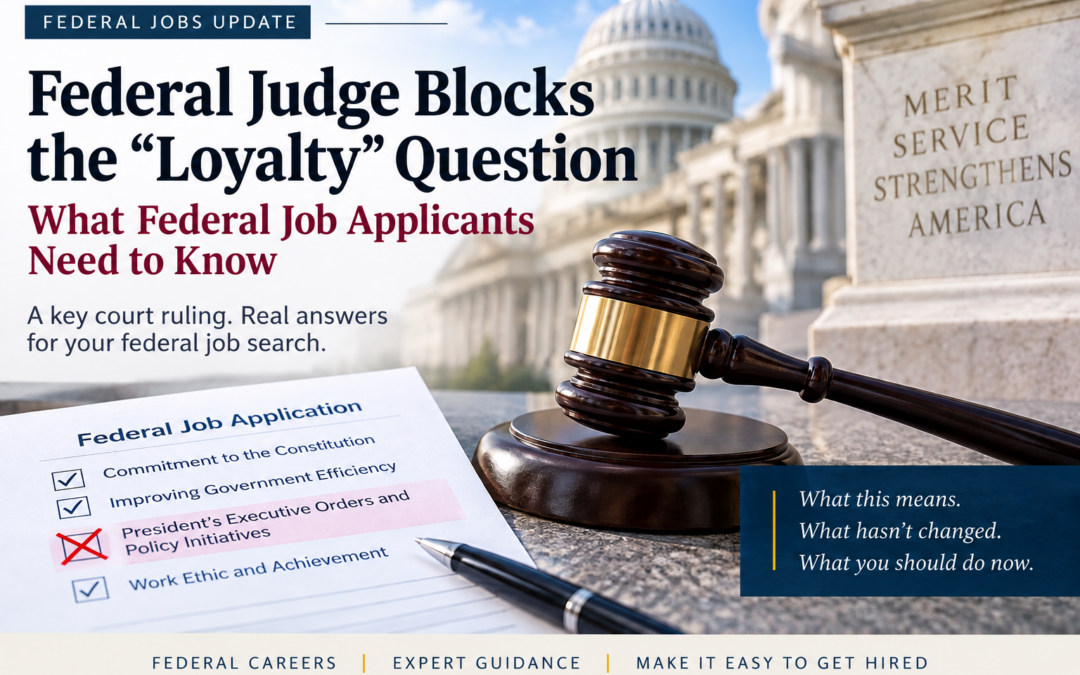
A federal judge has temporarily blocked Question 3 of the federal Merit Hiring essays, the question about advancing presidential executive orders and policy priorities. The other essay questions have not disappeared. Federal applicants should understand what the ruling changed, what remains in place, and how to prepare their own responses while following OPM’s rules on AI and outside assistance.
If you are applying for a federal job, the federal Merit Hiring essays have changed…again.
On September 11, 2026, U.S. District Judge George A. O’Toole Jr. stayed the use of Question 3 while litigation continues. That question asks applicants how they would help advance the President’s executive orders and policy priorities.
You may have seen it described as the federal hiring “loyalty question.” However, the ruling did not eliminate all four essay questions.
That distinction matters if you are applying for a federal position now.
What Happened to the Federal Merit Hiring Essays?
The Merit Hiring Plan introduced four short essay questions for many federal job applications. OPM’s April 2026 guidance says their use is mandatory for GS-5 through GS-15 and Senior Professional positions, with specified exceptions. They are optional for merit promotion announcements.
Three unions challenged Question 3 in federal court. The question asks applicants to identify one or two relevant executive orders or policy initiatives that are significant to them. Applicants are then asked to explain how they would help implement them if hired.
Judge O’Toole granted a stay as to Question 3. The court concluded, at this stage of the case, that the plaintiffs were likely to succeed on their challenge. This is interim relief while the litigation continues, not a final decision resolving the entire case.
OPM was directed to notify agencies and remove Question 3 from hiring announcements.
Are the Other Federal Merit Hiring Essays Still in Place?
Yes. The September 11 order addressed Question 3, not the entire set of essay questions.
The original Merit Hiring Plan included four questions. They address commitment to constitutional principles, government efficiency and effectiveness, presidential policy priorities, and work ethic.
With Question 3 stayed, applicants should not assume the entire essay component has disappeared.
There is another important detail. OPM’s April 30, 2026 guidance states that applicants must not be disqualified or screened out for declining to answer the questions.
The responses must not be marked as required, and applicants must be allowed to complete the application without answering them.
That makes careful reading of the current announcement and application instructions especially important.
What If You Already Answered Question 3?
The court’s order does not erase responses already submitted.
The plaintiffs sought broader relief that would have prevented agencies from considering previous answers or an applicant’s decision not to answer Question 3. The court declined to extend the stay that far.
Therefore, do not assume that an answer you previously submitted has automatically disappeared from your application.
This is also a good reminder to keep your own application records. Save the vacancy announcement, resume, questionnaire responses, essays, and supporting documents you submit.
What Should Federal Job Applicants Do Now?
Start by reading the announcement and application instructions.
Federal hiring requirements have changed significantly since the Merit Hiring Plan was introduced. Court action can create additional changes. Therefore, information from an older application may not match what you encounter today.
Pay particular attention to which essay questions appear and the instructions attached to them.
Also remember that OPM distinguishes between including the questions and requiring applicants to answer them. Under OPM’s April 2026 guidance, applicants cannot be screened out or disqualified simply because they do not answer the questions.
If you choose to respond, prepare carefully. A 200-word limit leaves little room for vague language.
How Should You Approach the Remaining Federal Merit Hiring Essays?
Start with evidence, not with what you think someone wants to hear.
The strongest response begins with a clear understanding of the question. Then identify a specific experience that supports your answer.
For example, a question about improving government efficiency should lead you to relevant evidence. Perhaps you improved a process, reduced costs, increased accuracy, shortened turnaround time, or improved an outcome.
Your response should make your contribution clear. What was happening? What did you do? What changed because of your actions?
That approach is more useful than filling 200 words with general statements. It also helps you avoid simply repeating your resume.
Your Federal Resume Still Has to Do the Heavy Lifting
The attention surrounding the essays can distract applicants from another major change in federal hiring.
The Merit Hiring Plan established a two-page limit for federal resumes, and OPM subsequently issued applicant guidance on that requirement.
A shorter resume does not mean your qualifications matter less. It means you have less space to communicate them. Your resume needs to show the work you performed, its scope and complexity, and the results you produced. It also needs to make relevant experience easy to find.
The essay and resume serve different purposes. However, both require you to choose evidence strategically.
Can You Use AI to Write Federal Merit Hiring Essays?
No. This is one area where the instructions are unusually specific.
The Merit Hiring Plan states that applicants must certify they used their own words and did not use a consultant or AI, including an LLM. OPM’s subsequent guidance repeats that certification requirement. Therefore, I would not recommend asking ChatGPT, Copilot, Claude, or another AI tool to write a response you intend to submit.
I also would not recommend having a resume writer or career coach write the response for you.
That does not mean you have to stare at a blank page wondering where to begin.
You can use my thinking framework to help identify your own evidence and organize your thoughts. You still supply the experiences, judgment, and words.
That distinction is why I developed the M.E.R.I.T. Essays Framework™.
How Does the M.E.R.I.T. Essays Framework™ Help?
The M.E.R.I.T. Essays Framework™ provides a structure for thinking through the remaining federal Merit Hiring essays without writing your answers for you.
M: Motivation
Why does the principle, responsibility, or issue in the question matter to you professionally?
E: Example
What specific experience provides evidence for your answer?
R: Response
What did you do? Focus on your actions, decisions, and contributions.
I: Impact
What happened as a result? Look for a measurable result, improvement, outcome, or meaningful lesson.
T: Tie-Back
How does the example connect directly to the question and the federal position?
The framework gives you a way to move from a broad question to relevant evidence and then organize that evidence logically.
I guide you. You write it.
Get the Free M.E.R.I.T. Essays Framework™ Below
If you are preparing for the remaining federal Merit Hiring essays, I created a free resource to help you organize your thinking.
The M.E.R.I.T. Essays Framework™ walks you through Motivation, Example, Response, Impact, and Tie-Back. You identify the experiences. You decide what they mean. You write the response.
Click HERE to get the Free M.E.R.I.T. Essays Framework™
Federal hiring will continue to change. Applicants cannot control every policy change or court ruling.
You can control how carefully you read the requirements, how well you understand your value, and how clearly you communicate your qualifications.
Make it Easy to Get Hired!
Frequently Asked Questions
Did the judge eliminate all four federal Merit Hiring essays?
No. The September 11, 2026 order stayed Question 3 while the litigation continues. It did not eliminate the entire set of Merit Hiring essay questions.
What is Question 3?
Question 3 asks how an applicant would help advance the President’s executive orders and policy priorities. It also asks applicants to identify one or two relevant initiatives significant to them and explain how they would help implement them.
Are applicants required to answer the remaining questions?
OPM’s April 30, 2026 guidance says applicants must not be disqualified or screened out for not answering the questions. Responses must not be marked as required, and applicants must be allowed to complete the application without answering them.
What if I already answered Question 3?
The court declined to prevent agencies from considering previously submitted answers or an applicant’s decision not to answer. Therefore, do not assume a previously submitted response has automatically been removed.
Can AI write my federal Merit Hiring essays?
The Merit Hiring Plan requires applicants to certify that they used their own words and did not use a consultant or AI, such as a large language model. Applicants should follow the certification and instructions presented in their specific application.
How long can the essay responses be?
OPM guidance specifies a maximum of 200 words per question.
Sources
OPM: Merit Hiring Plan
OPM: April 2026 Guidance on the Four Essay Questions
Federal Court Order: AFGE v. Kupor
Federal News Network: September 2026 Court Ruling

She also partners with entrepreneurs and business owners, applying the same Magnetic Positioning™ principles to help them attract the right clients and referrals.
Her services include career marketing: federal and private-sector resumes, LinkedIn profiles, interview and salary negotiation strategy, one-sheets, company pages, outplacement support, and AI implementation.
She publishes Magnetize Your Career, a blog and LinkedIn newsletter for mid-career professionals and executives across federal government, private sector, and military.
Learn more at cccareersolutions.com.
You've got this, and I've got you.
#KeepGoing
- US Tech Force: Who It Fits and How to Get Ready - October 7, 2026
- Federal Merit Hiring Essays:Judge Blocks Question 3 - September 17, 2026
- AI in Federal Hiring: What OPM’s New Memo Means for Your Next Application - September 4, 2026