
Leadership identity separation is one of the most underdeveloped yet essential leadership disciplines. When leaders fail to separate who they are from what they are experiencing, judgment becomes distorted, decisions become reactive, and long-term effectiveness weakens over time. In moments of uncertainty, delay, or transition, the ability to distinguish identity from circumstance often determines whether a leader maintains clarity or begins compensating unnecessarily.
This challenge rarely announces itself dramatically. Instead, it emerges when momentum slows, visibility shifts, or expectations change. Those who were once grounded may begin questioning their relevance, direction, or value. Without realizing it, external conditions start shaping internal certainty.
Understanding leadership identity separation provides a stabilizing framework for navigating these moments with deliberation rather than urgency.
Why Leadership Identity Separation Matters During Uncertainty
Leadership roles are often intertwined with responsibility, contribution, and measurable outcomes. Over time, identity becomes closely linked to position, influence, or progress. When forward movement is consistent, this alignment feels natural and reinforcing. However, when circumstances shift, that same alignment becomes fragile.
Uncertainty magnifies internal questions. Leaders may interpret stalled progress as personal failure rather than contextual fluctuation. Silence begins to feel pointed. Delay starts to feel disqualifying. As a result, decisions are shaped by the desire to restore certainty rather than by sound judgment.
Leadership identity separation prevents this erosion. It allows leaders to remain steady even as conditions change, preserving perspective when it matters most.
The Identity Separation Principle
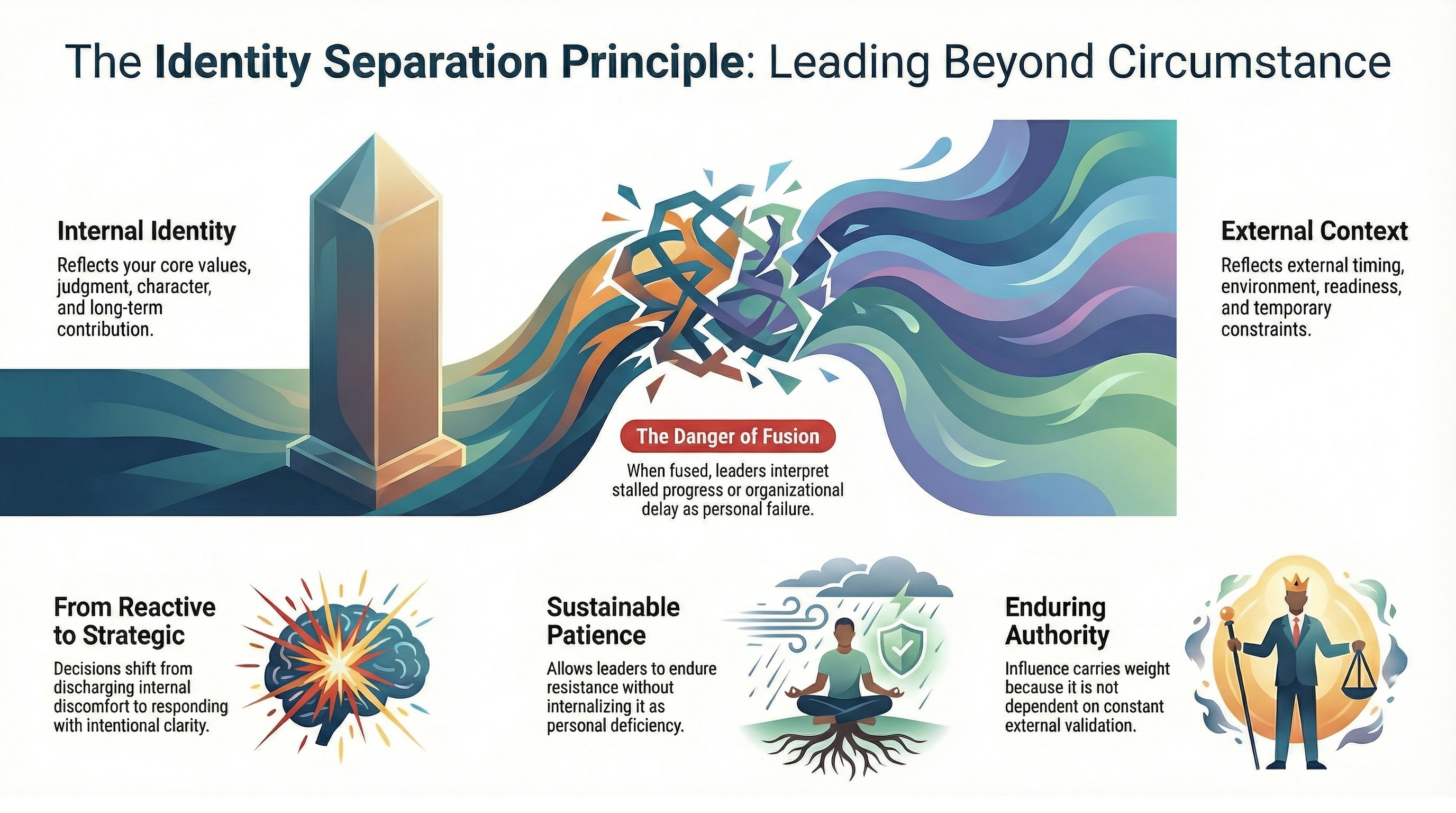
The Identity Separation Principle is straightforward but demanding. It requires leaders to distinguish between identity and context. Identity reflects values, judgment, character, and long-term contribution. Context reflects timing, environment, readiness, and external constraints. When these two are fused, leaders experience instability. When they are separated, leaders gain proportion.
This separation does not reduce ambition or engagement. It strengthens both. Leaders who are no longer seeking validation from immediate outcomes can evaluate opportunities objectively, tolerate ambiguity, and respond with intention rather than impulse.
Leadership identity separation allows leaders to remain decisive without becoming reactive.
Leadership Identity Separation and Decision-Making Under Pressure
Pressure is often where identity confusion becomes most costly. Leaders under scrutiny may feel compelled to act quickly, speak prematurely, or commit to paths that provide reassurance rather than wisdom. In these moments, action becomes a way to discharge discomfort rather than a response to clarity.
Identity separation restores balance. Leaders can pause without disengaging. They can evaluate feedback without internalizing it. They can recognize when resistance reflects timing or readiness rather than personal inadequacy.
This discipline creates space for discernment. Leaders become less vulnerable to urgency-driven decisions and more capable of aligning action with long-term objectives.

Leadership Identity Separation and Career Decisions
Leadership identity separation does not only shape how leaders behave under pressure. It directly affects how they evaluate their careers when conditions change.
When identity and circumstance are fused, career questions become reactive. Leaders start scanning for exits, promotions, or moves as a way to restore certainty rather than to respond to genuine misalignment. A slowdown feels like a warning. Reduced visibility feels like a verdict. Structural shifts begin to feel diagnostic.
Identity separation changes the nature of those decisions.
When leaders distinguish who they are from what they are experiencing, they can assess career options with clarity rather than urgency. Sometimes the role still fits and the environment is simply in flux. Other times, the leader has evolved beyond the scope of the role, even if performance remains strong. Both require different responses.
This is where career marketing becomes translation, not escape.
Instead of compensating for discomfort, leaders can represent their experience accurately. Judgment, scope, and decision-making capacity become the focus rather than recent visibility or temporary conditions. Promotion conversations become grounded. External opportunities can be evaluated without panic.
Leadership identity separation allows leaders to decide whether to stay, reposition, or move with intention rather than reflex.
A Practical Example of Leadership Identity Separation
I’ve worked with senior leaders who built their credibility through consistent delivery. Their roles expanded over time. Their input mattered. Decisions moved because they were involved. Then something changed.
In one case, a client went through a reorganization that reduced their scope. Decision authority shifted. Projects slowed. They were no longer pulled into conversations at the same cadence. There was no negative feedback. No performance issue. Just a structural change that altered visibility.
What followed was not a loss of capability, but a moment of internal destabilization.
The client began questioning their relevance. Not publicly, but privately. They wondered whether they needed to speak more, push harder, or manufacture urgency where none had been requested. The impulse was understandable. When identity and role are tightly linked, reduced visibility can feel personal even when it is not.
This is where identity separation made the difference.
Instead of reacting, we focused on distinguishing what had changed from who they were. The environment had shifted. Their judgment, standards, and leadership capacity had not. Once that distinction was clear, their behavior changed.
How Leadership Identity Separation Changed the Outcome
Their preparation remained consistent. Moreover, they contributed when it mattered. Instead of performing for reassurance, they allowed influence to re-accumulate rather than forcing it.
Months later, when decisions resurfaced and trust became essential again, their presence carried weight precisely because it had not been overextended. Their authority held because it was not dependent on constant affirmation.
The outcome was not about confidence or visibility. It was about separating identity from circumstance and allowing leadership to remain intact while conditions evolved.
How Leadership Identity Separation Supports Patience
Without identity separation, patience becomes difficult to sustain.
Waiting feels intolerable when identity is at stake. Silence feels personal. Delay feels like evidence that something is wrong. As a result, leaders may begin interpreting normal fluctuations as signals of personal deficiency rather than recognizing that leadership often unfolds unevenly.
Leadership identity separation restores proportion. It allows leaders to experience resistance without internalizing it and to practice patience without feeling diminished by it. Furthermore, when identity remains intact, leaders can interpret feedback accurately and endure ambiguity without self-erosion.
This principle builds on the previous one in the series, which explored patience as a leadership discipline rather than a personality trait.
Together, these principles reinforce the internal stability required for sustained leadership effectiveness.
Leadership Identity Separation in Transition and Continuity
This principle applies both during transition and continuity.
For leaders navigating career transitions, leadership identity separation prevents changes in role from becoming crises of self. It enables reflection without self-judgment and movement without panic. Therefore, leaders shift from asking how to regain relevance to considering what aligns with their long-term direction.
For leaders who remain in role, identity separation guards against over-identification with position or momentum. It prevents ego from becoming brittle and authority from becoming conditional. Leaders remain grounded even as visibility fluctuates.
In both contexts, identity becomes an anchor rather than a liability.
Why This Principle Endures
Trends shift. Markets change. Leadership styles evolve. What remains constant is the need for leaders who can withstand pressure without being consumed by it.
Leadership identity separation is not detachment. It is alignment. It allows leaders to remain open to learning, correction, and growth without collapsing inward when outcomes lag. It protects judgment, strengthens endurance, and supports principled decision-making over time.
When leaders stop allowing circumstances to define them, they gain the freedom to respond strategically rather than defensively.
The question is not how quickly momentum can be restored.
The more important question is whether identity remains stable while context evolves.
That distinction often separates leaders who endure from those who merely react.
Before you rush to restore momentum, it may be worth asking a different question.
What would change if you stopped allowing circumstances to define how you assess yourself as a leader?
For many executives, that shift marks the moment when decisions become clearer, patience becomes sustainable, and leadership stops feeling reactive.
If this principle resonates, I welcome your perspective.
How have changes in role, visibility, or momentum affected the way you evaluate yourself as a leader?
Leadership Beyond Immediate Conditions
Leadership identity separation does not only surface during disruption. It becomes more critical as leaders move into senior roles where feedback is less frequent, outcomes are complex, and visibility fluctuates by design. At higher levels, influence often operates through judgment rather than action, and effectiveness is not always immediately observable. Leaders who depend on constant external validation struggle in these conditions.
When identity is stable, leaders can operate within this ambiguity without distortion. They evaluate opportunities more accurately, represent themselves with clarity, and avoid overcorrecting in response to temporary signals. Over time, this steadiness becomes a differentiator. Leaders who are not defending identity make better decisions, communicate with precision, and are trusted when discernment matters more than speed.
Extending the Principle Across the Series
This principle builds on the previous one in the series, which explored why patience becomes difficult to sustain when delay is interpreted as failure rather than information. Identity separation makes patience possible. When leaders are no longer protecting who they are, they can choose timing deliberately, absorb uncertainty without overreaction, and allow clarity to emerge without forcing outcomes.
As this series continues, the focus will move toward how leaders interpret feedback, decide what deserves attention, and maintain judgment under pressure. Those capabilities rest on the same foundation. Leadership identity separation allows leaders to remain effective as roles, visibility, and conditions evolve.
Research on how leaders develop stronger judgment and self-awareness consistently points to the importance of separating personal identity from external performance metrics.
What changes when leadership identity remains intact, even as circumstances shift?
I welcome your thoughts.

She also partners with entrepreneurs and business owners, applying the same Magnetic Positioning™ principles to help them attract the right clients and referrals.
Her services include career marketing: federal and private-sector resumes, LinkedIn profiles, interview and salary negotiation strategy, one-sheets, company pages, outplacement support, and AI implementation.
She publishes Magnetize Your Career, a blog and LinkedIn newsletter for mid-career professionals and executives across federal government, private sector, and military.
Learn more at cccareersolutions.com.
You've got this, and I've got you.
#KeepGoing
- Federal Merit Hiring Essays:Judge Blocks Question 3 - September 17, 2026
- AI in Federal Hiring: What OPM’s New Memo Means for Your Next Application - September 4, 2026
- Hope After a Layoff: Rebuild Your Career With Confidence - August 10, 2026