
Quick answer: What is the Emotional Containment Principle?
At its heart, the Emotional Containment Principle is about carrying strong feelings with care. You feel the frustration, the disappointment, or the alarm, and you decide when and how it’s expressed. That discipline protects your judgment, steadies the people watching you, and keeps one hard moment from becoming a lasting reputation.
“Please don’t hit send.”
I’ve thought those words on several occasions while coaching a leader through a career transition, usually right after hard news, when they’re tempted to send a reactionary email. You’ve probably watched a room change temperature in a single sentence, too. That’s the moment the Emotional Containment Principle was made for.
Someone hears something difficult, reacts a little too fast, and suddenly the meeting is no longer about the problem. It might be a reorganization, a layoff notice, or an interview that went silent for two weeks. Strong feelings are information, not instructions, and you can feel every bit of them while you still choose what happens next.
Strong feelings are information, not instructions.
Last time, we looked at how effective leaders neither fight every boundary nor give in to every limitation, and look instead for where responsible movement is still possible. This is its natural companion.
You can read that piece here: The Constraint Navigation Principle.
What Is the Emotional Containment Principle?
The Emotional Containment Principle is the leadership discipline of giving your judgment time to catch up with strong emotion. I like the word containment because a container doesn’t destroy what it holds. It simply keeps the contents from spilling onto everyone nearby.
Here is what I’ve seen over many years of working with senior leaders: at your level, your reaction carries more weight than your words. Your team reads your face, your pace, and your pauses before they hear a single word of analysis. When you react sharply, people stop solving the problem and start managing you.
It’s easy to miss this from the inside. Your reaction feels honest and proportionate to you, but the people around you read it as a signal of whether bringing you bad news is safe, and that shapes what reaches your desk over time. The information you receive is only as accurate as your reputation for receiving it calmly.
How the Emotional Containment Principle Differs from Suppression
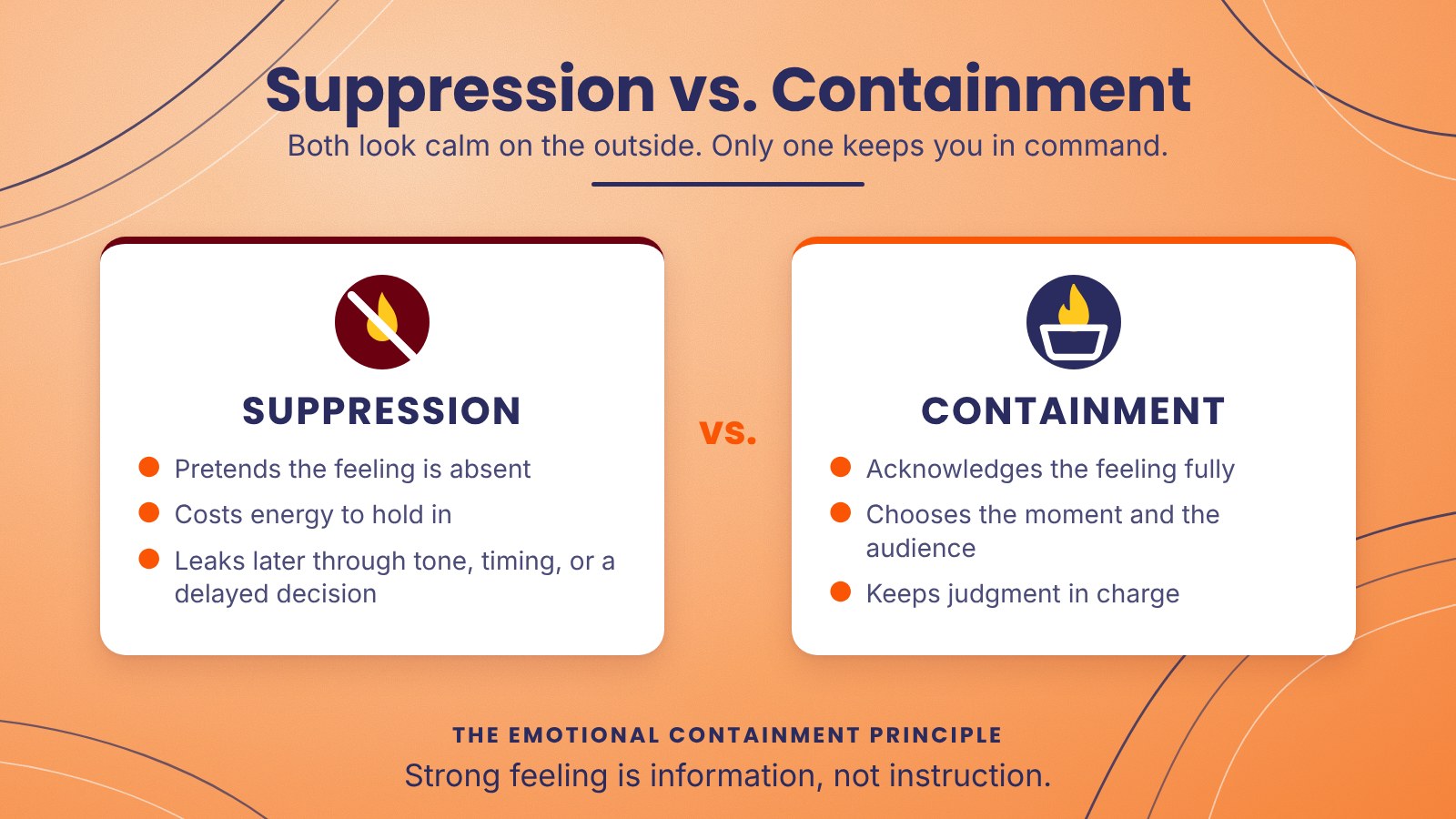
Many people confuse containment with suppression, and I understand why. Suppression pretends the feeling isn’t there, which takes a great deal of energy and usually leaks out later in your tone, your timing, or a delayed decision. Containment admits the feeling fully, then chooses the right moment and the right audience for it.
You might say, “I am frustrated by this, and I need until tomorrow to respond well.” That sentence is honest, specific, and free of drama. It tells your team the concern is real without asking them to carry it for you.
Why Do Strong Leaders Absorb More Than They Show?
Perhaps you live inside a one-way mirror. People bring you their worry, disappointment, and conflict, and they expect you to take it in and hand back clarity. That expectation is reasonable, and it’s also heavy.
Much of what you absorb doesn’t belong to you. A direct report’s worry about a reorganization, a board member’s irritation, and a peer’s defensiveness can all land on your desk looking like urgent problems. Containment begins with sorting what is yours from what you’re simply holding for someone else.
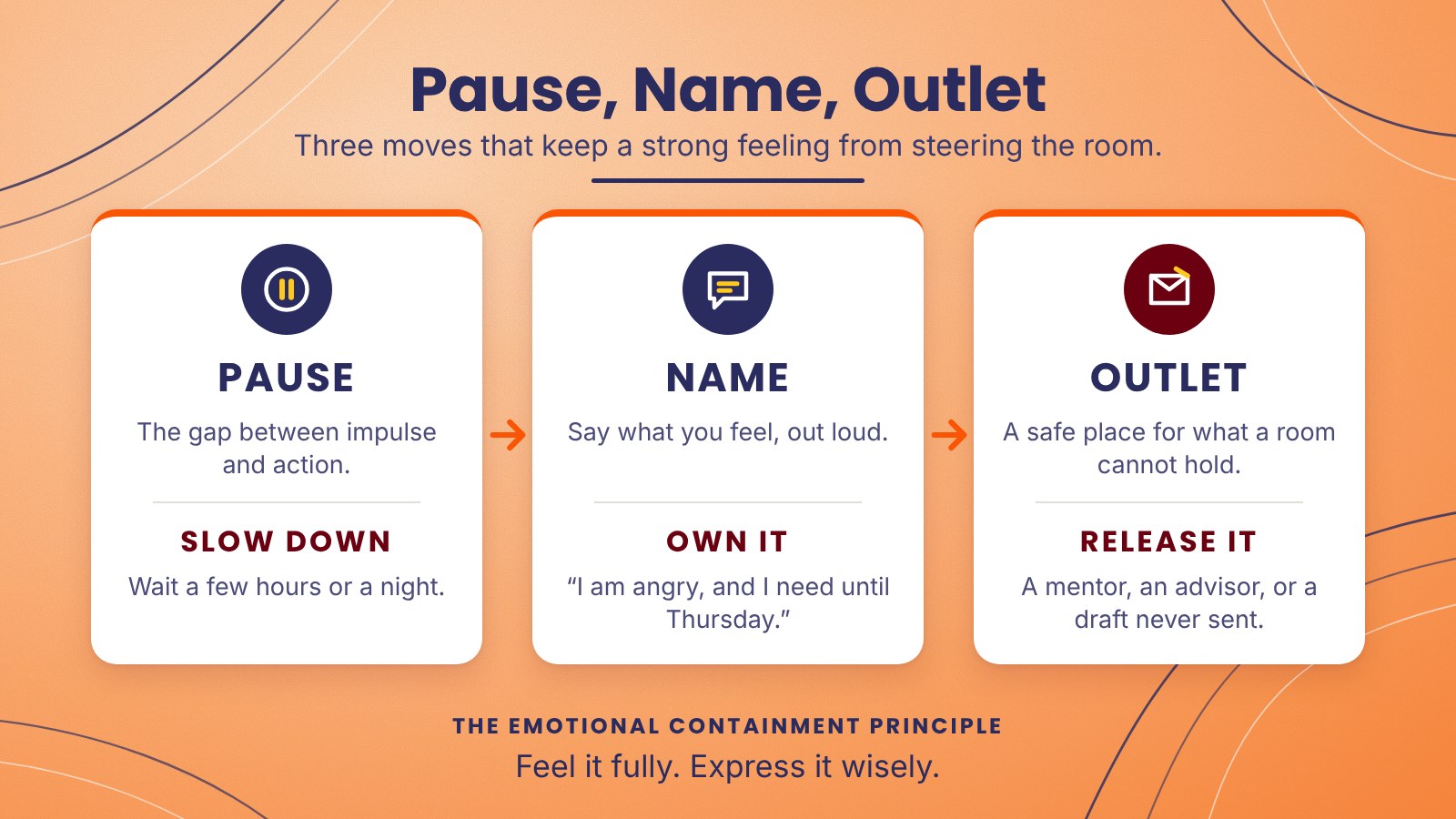
That sorting takes practice because your body responds before your mind has a chance to categorize. Your pulse rises, your reply forms, and the draft email starts to feel justified. The pause between that impulse and your action is the whole discipline, and it’s often smaller than you expect: a few hours, or one night of sleep.
The pause between the impulse and your action is the whole discipline.
An Example from My Work
I worked with a senior director who learned in a staff meeting that her program was being folded into another division. She hadn’t been consulted, and the announcement happened in front of her peers.

She told me she felt blindsided first, then embarrassed that everyone watched it happen. By the time she reached her office, the embarrassment had turned into anger. Underneath it was fear for her team’s jobs and for the projects the public depended on.
She kept her expression steady through the rest of the meeting. Then she gave the feeling somewhere to go. She drafted a long email to the executive who made the decision, and every sentence in it was true.
When we discussed the situation, she decided to read me what she wrote. I remember thinking, “Please don’t hit send.” Halfway through, she stopped and said it sounded like someone she didn’t want to be in that organization.
I let her talk through the situation, and then I asked whether she could outline an alternative. That was the turning point. She named what she was feeling out loud: “I am angry, and I need until Thursday to respond well.”
The email never went out. She wrote a short message asking for time to discuss the transition, and she kept the longer draft for herself.
What Changed Because She Held Steady
Two days later, she met with the executive and raised three of the same concerns: the timeline, the risk to her team’s jobs and the public projects they supported, and the lack of anyone assigned to lead the handoff. She asked questions instead of making accusations, and she arrived with a one-page proposal. She framed each concern around the people the program served, not around her own position.
Because she arrived steady, he listened. He agreed to keep her team and the public projects on track through the transition, extended the timeline by a full quarter, and asked her to lead the integration planning.
Notice what she didn’t do. She didn’t pretend she was fine, and she didn’t share her anger in front of her peers. She felt it fully, gave it an outlet, and let her judgment decide when and how it was expressed.
That’s the Emotional Containment Principle in practice.
Six months later, she was running the combined function. The decision itself never reversed. What changed was her position inside it.
What Does Emotional Containment Look Like in Practice?
Containment is rarely dramatic. It looks like slowing down the pace of a reply, asking one more question before you react, or saying that a decision will come after the data does.
The outlet matters just as much. Strong feelings still need somewhere to go, and a trusted advisor, a mentor, or a private journal can hold what a conference room cannot. The draft you never send and the walk you take before responding are both forms of containment, because they move the feeling somewhere it can be examined instead of broadcast.
What Does Emotional Containment Mean During a Career Transition?
A job search is an emotional endurance event, and I say that with real compassion for anyone in the middle of one. Silence after an interview, a rejection that arrives with no explanation, and a recruiter who disappears can all pull a seasoned professional toward reactions that don’t reflect their experience. A sharp reply, a pleading follow-up, or visible discouragement on a networking call can shape how a decision-maker remembers you.
Hiring leaders are often assessing how you handle pressure while they assess your qualifications. They’re watching how you respond when the process gets slow, uncertain, or disappointing.
The way you carry disappointment during the process is evidence they can observe directly.
Containment in this setting doesn’t mean pretending the search is easy. It means choosing where the frustration goes, so your messages, interviews, and conversations carry the clarity your career has earned. Your résumé and LinkedIn profile make the case on paper, and your composure makes the same case in person.
Moments like these are also the stories your career marketing needs to tell. A résumé lists responsibilities, while a story about how you held steady under pressure shows the judgment behind them, and judgment is what decision-makers are really hiring.
Holding Steady Without Going Numb
The goal isn’t to become a leader who feels nothing. People follow leaders who care, and that care shows in what you protect, not in how loudly you react.
Containment keeps your feeling intact while keeping your judgment in charge. The leaders who endure treat emotion as accurate information that deserves a thoughtful response, delivered at the right time to the right audience.
Knowing who you are, in these moments, is what makes the pause possible. Notice what tends to set you off, where you feel it in your body, and what you usually do next. When you know your own pattern, you can catch it early and choose your response instead of letting the moment choose it for you.
Which situation in your current role would improve if you waited one day before responding? If you’re not sure, that’s exactly where we start.
If you’re in the middle of a career transition right now, I want you to hear this from me. The silence, the rejections, and the waiting aren’t a verdict on your worth, and they aren’t the end of your story.
Be gentle with yourself on the hard days. Feel what you feel, give it a safe place to go, and keep your next step small enough that you can take it today.
Let’s Walk Through It Together
I’ve watched capable people come through seasons exactly like this one, and they came out clearer about what they bring and what they want. If you would like a steady partner while you work through yours, I’d be glad to walk through it with you.

Frequently Asked Questions: The Emotional Containment Principle
What is the Emotional Containment Principle in leadership?
The Emotional Containment Principle is the leadership discipline of feeling strong emotion fully while choosing when and how it’s expressed. You give your judgment time to catch up with the feeling. Your reaction stops driving the room, and your decision does.
Is emotional containment the same as suppressing your emotions?
No, because suppression pretends the feeling is absent, which costs energy and usually leaks out later in your tone or timing. Containment acknowledges the feeling honestly, then chooses the right moment and the right audience for it. A sentence such as “I am frustrated, and I need until tomorrow to respond well” is containment.
Why does a leader’s emotional reaction affect the whole team?
At senior levels, your reaction carries more weight than your words. Your team reads your face, your pace, and your pauses before they hear your analysis. When you react sharply, people stop solving the problem and start managing you, which also changes what information reaches you.
How do I practice emotional containment when I am angry or blindsided?
Start with a pause: wait a few hours, or until the next day, before responding to anything that triggered you. Give the feeling an outlet that’s not the room, such as a draft you never send, a walk, or a trusted advisor. Then name the feeling plainly and decide which response serves the outcome you want.
Does emotional containment mean I should never show emotion at work?
No, because people follow leaders who care, and care shows up in what you protect. The goal is to share emotion at the right time, with the right audience, and in proportion to the situation. Containment keeps the feeling intact and keeps your judgment in charge.
How does the Emotional Containment Principle apply during a job search?
A job search tests your composure through silence, rejection, and delay. A sharp reply or a pleading follow-up can shape how a decision-maker remembers you. Hiring leaders often assess how you handle pressure while they assess your qualifications, so your composure is part of your evidence.
How can I tell if I am leaking emotion instead of containing it?
Watch for delayed decisions, a sharper tone than the situation warrants, and teams that stop bringing you bad news. Those are signs the feeling is leaking instead of being directed. Ask yourself whether people are solving the problem or managing your reaction.

She also partners with entrepreneurs and business owners, applying the same Magnetic Positioning™ principles to help them attract the right clients and referrals.
Her services include career marketing: federal and private-sector resumes, LinkedIn profiles, interview and salary negotiation strategy, one-sheets, company pages, outplacement support, and AI implementation.
She publishes Magnetize Your Career, a blog and LinkedIn newsletter for mid-career professionals and executives across federal government, private sector, and military.
Learn more at cccareersolutions.com.
You've got this, and I've got you.
#KeepGoing
- The Emotional Containment Principle: Staying Steady When Your Career Is in Transition - October 31, 2026
- You Could Qualify for a $315,000 Salary and Still Get Passed Over. Here’s Why + How to Fix - October 30, 2026
- What a $405,000/Annual AI Job and Senior Federal Roles Reveal About Magnetic Positioning™ - October 18, 2026