Quick Answer: What is the AI impact on careers?
AI is reshaping specific tasks inside professions, not eliminating careers overnight. A 2025 Anthropic study found that while AI could theoretically assist with a large share of professional tasks, actual adoption remains low and unemployment in exposed roles has not measurably increased. The most significant career shift is this: as execution becomes easier for everyone, strategic thinking and career positioning become the sharpest competitive advantages. Professionals who learn to use AI as a strategy tool, not just a shortcut, will have a measurable edge in hiring.
A new Anthropic study is generating a lot of conversation. But the most important finding for job seekers is not the one making headlines. Here is what the AI impact on careers really looks like and what you should do about it.
AI is taking our jobs. Or is it?
A recent analysis from Anthropic found that while artificial intelligence could theoretically assist with a significant share of tasks across many professions, actual adoption remains a fraction of that theoretical capability. So far, there is no measurable increase in unemployment for workers in the most exposed roles.
But when I studied the data more closely, I noticed something that stopped me.
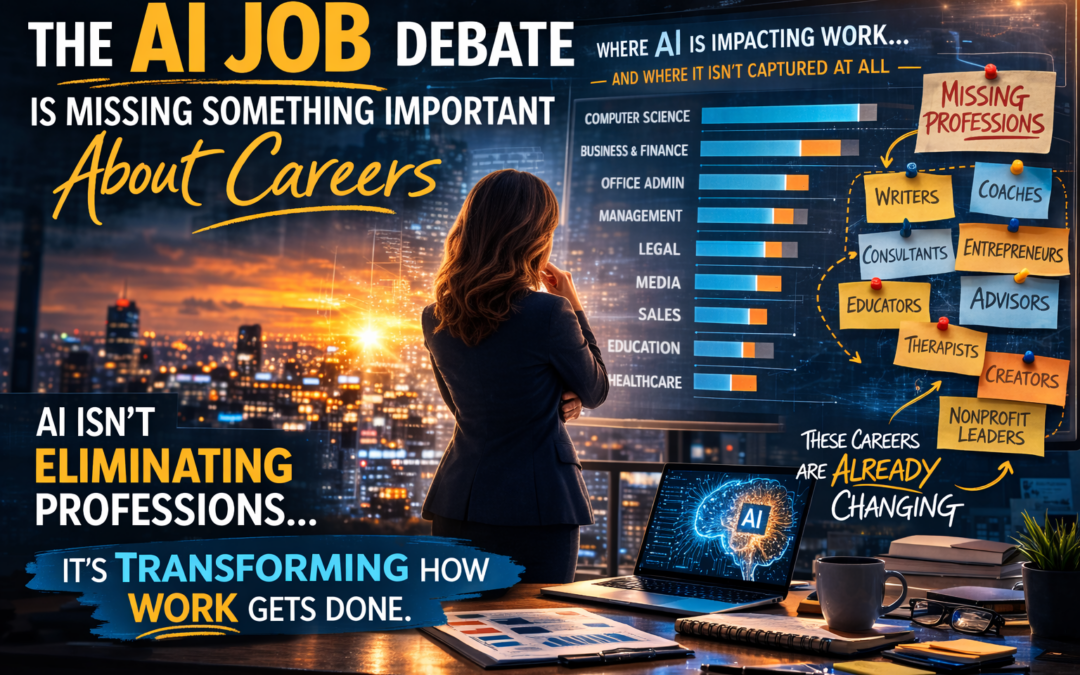
Entire professions were missing from the conversation.
And that absence reveals something important about how most people are reading this research and what it actually means for your career.
What Did the Anthropic Research Find About the AI Impact on Careers?
Anthropic published new research examining how large language models interact with job tasks across the economy. The analysis uses occupational data from O*NET, a framework widely used by economists and workforce researchers to categorize professions and understand how work is performed.
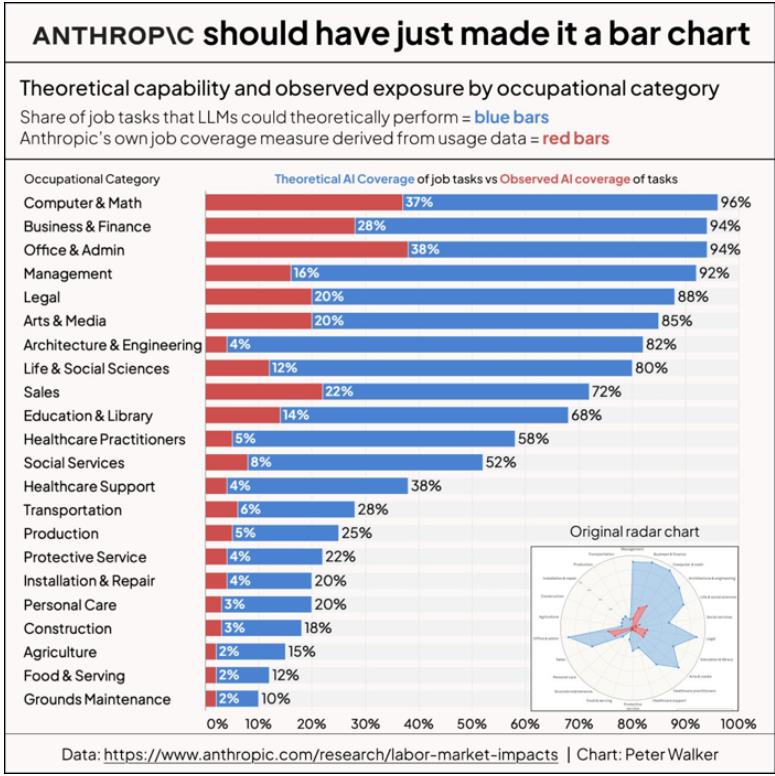
Shortly after the research appeared, Peter Walker, a data storyteller at Carta, translated the findings into a bar chart visualization that quickly began circulating across professional communities.
I had been studying the research when I received an email invitation to a public town hall hosted by another data storyteller, author, and entrepreneur Ryan Levesque, where the research sparked a genuinely interesting conversation about the AI impact on careers and the future of professional work. His observations added a layer to what I was seeing in the data.
Like many people studying the analysis, I found the data fascinating. But I also found it incomplete in a way that matters to job seekers specifically.
Several professional fields appear prominently in the chart, including computer science, business and finance, office administration, management, legal work, and media. These fields show significant interaction between AI and the tasks people perform inside those roles.
That can feel alarming at first glance. But the data does not suggest entire professions are disappearing. It shows that AI is beginning to interact with specific tasks inside those professions. That is a distinction worth sitting with.
Technology has always reshaped how work is performed.
Computers replaced typewriters. Spreadsheets changed accounting. Email transformed communication. The internet reshaped publishing and media. Artificial intelligence is accelerating that long pattern of change, but at a pace far faster than previous technological shifts. The difference this time is not the direction of change. It is the speed.
The chart as interpreted by Peter Walker.
The Professions the Chart Does Not Show
The occupational framework used in the research, O*NET, groups professions into broad categories, including computer and mathematics, healthcare, business and finance, education, sales, and management. But many modern professional roles no longer sit comfortably inside a single category.
Some of the professions that do not appear clearly in this analysis include writers, authors, and content creators, resume writers and career strategists, executive coaches and business coaches, independent consultants and advisors, educators and course creators, entrepreneurs and solopreneurs, therapists, counselors, and wellness professionals, nonprofit leaders and community organizers, independent financial advisors and estate planners, and artists, designers, and creative directors working independently.
These are roles built on interpretation, judgment, communication, and human connection. Because they span several disciplines, they do not always show up clearly in datasets built around traditional job classifications.
But here is what every job seeker needs to understand: just because a profession does not appear clearly in the chart does not mean it is unaffected.
Many of these professionals are already experiencing some of the most significant AI-driven changes in the workforce. And the hiring landscape surrounding all of these fields is shifting, whether the data captures it or not.
That means job seekers cannot rely on headline research alone to understand their own exposure or develop a smart AI career strategy for job seekers.
“Missing from the chart does not mean safe from change. The AI impact on careers is reshaping hiring across every field, including the ones the data cannot easily measure.” Camille Carboneau Roberts, CC Career Solutions
When AI Makes Execution Easy, What Happens to Career Strategy?
During his public town hall, author and entrepreneur Ryan Levesque offered an observation that has stayed with me.
When execution becomes easier, strategy becomes harder.
AI dramatically reduces the effort required to perform many professional tasks. Drafting documents, summarizing information, organizing research, generating ideas. These can now happen far faster than they could just a few years ago.
But as execution becomes easier for everyone, the real differentiator shifts.
The advantage no longer comes from producing information. It comes from knowing what information matters, how it should be structured, and how it should be positioned.
The value shifts from doing the work to deciding what work should be done in the first place.
For job seekers, this means something very specific. The professionals and executives who learn to use AI as a strategic tool rather than a shortcut will stand out. Not because they can produce more, but because they can think more clearly about what their experience means, where it fits, and how to communicate it in a market that is moving fast. That is why understanding the AI impact on careers is the most valuable competitive advantage available today.
What Does 30 Years of Career Strategy Tell Us About AI and Jobs?
For three decades, I have worked with professionals navigating complex career decisions, from federal employees across hundreds of agencies to executives throughout the private sector.
Over thousands of career conversations, one lesson has emerged consistently.
The greatest challenge professionals face is not writing a resume. It is understanding how to translate their experience into meaningful impact.
That challenge is not going away in an AI-driven world. It is intensifying. Job seekers are not just competing with each other. They are navigating a market where the tools available to every candidate are more powerful than they have ever been. The professionals who learn to use those tools strategically will have a significant advantage. The ones who wait will feel that gap widen.
If you are thinking about what AI is already doing to the job market, this is the right moment to start asking sharper questions about your own career positioning.
What Should You Do Right Now About the AI Impact on Your Career?
- AI is transforming specific tasks inside professions, not eliminating professions overnight. Understanding which of your tasks are shifting is where your attention belongs.
- Many careers span multiple disciplines and will not show up clearly in labor market research. You cannot wait for the data to tell you what to do next.
- As execution accelerates for everyone, strategic thinking, narrative clarity, and career positioning become your sharpest competitive advantages.
- Learning to work with AI is no longer optional for professionals and executives who want to stay relevant. It is part of how serious candidates show up in 2026.
The AI job debate will keep generating headlines. But the real story is not in the chart.
It is in what you decide to do while everyone else is still debating whether to be worried.
What are you seeing in your own field?
Has AI shifted the work you do or the roles you are pursuing?
Leave a comment below or reply to my email directly and let me know. I read and reply to every response.
Sources and References
Anthropic Research: https://www.anthropic.com/research/labor-market-impacts/
Peter Walker, Carta: https://www.linkedin.com/feed/update/urn:li:activity:7435739146293497858/
Ryan Levesque: https://www.linkedin.com/pulse/95-what-you-sell-become-free-so-important-im-hosting-town-levesque-z…
Frequently Asked Questions
Will AI really take my job?
AI is unlikely to take your job entirely, but it will change how you do your job. The real risk is not AI itself, but falling behind colleagues who learn to use AI effectively. Focus on developing skills that complement AI rather than compete with it.
What jobs are most at risk from AI?
Jobs involving routine data processing, basic content creation, simple customer service, and repetitive analysis are most at risk. However, even in these fields, roles requiring judgment, creativity, emotional intelligence, and complex problem-solving remain secure.
How do I stay relevant in an AI-powered workplace?
Stay relevant by learning to use AI tools in your field, developing strong communication and leadership skills, focusing on creative problem-solving, and building expertise in areas requiring human judgment. Continuous learning and adaptability are essential.
Should I learn to code to work with AI?
Basic coding knowledge can be helpful, but it’s not essential for most professionals. More important is understanding how to effectively prompt and interact with AI tools, interpret their outputs, and integrate them into your workflow.
What industries will see the biggest AI impact?
Healthcare, finance, legal services, customer service, and content creation are seeing major AI transformation. However, every industry will be affected to some degree. The key is understanding how AI will specifically impact your field and preparing accordingly.

I work with mid-career professionals and executives across the federal and private sectors when the stakes are high and the next move matters.
My work focuses on helping leaders make smart career decisions, clarify their leadership narrative, and navigate complex hiring environments with intention and perspective. I partner with clients at moments of transition, promotion, or repositioning, when experience is strong but the path forward requires judgment rather than generic advice.
With more than 25 years of experience advising professionals and senior leaders across nearly every federal agency, as well as Fortune 500 and global organizations, I bring a systems-based approach to career strategy. Rather than treating résumés, interviews, and career decisions as isolated tasks, I help clients build a coherent, future-focused approach to career management that blends human judgment with modern intelligence systems.
Clients work with me when they want clarity, strategy, and intelligent guidance for their best next move.
I would love to meet you and help you Get HIRED in your next role. Thank you for stopping by!
- 250 Federal Project Manager Jobs Just Opened: Get Your Resume Ready Quick! - April 4, 2026
- Federal RIF Performance Ratings: What You Need to Know - March 27, 2026
- The AI Impact on Careers Nobody Is Talking About - March 13, 2026