Quick answer:
SHADED Quick Answer: Degree vs Certifications
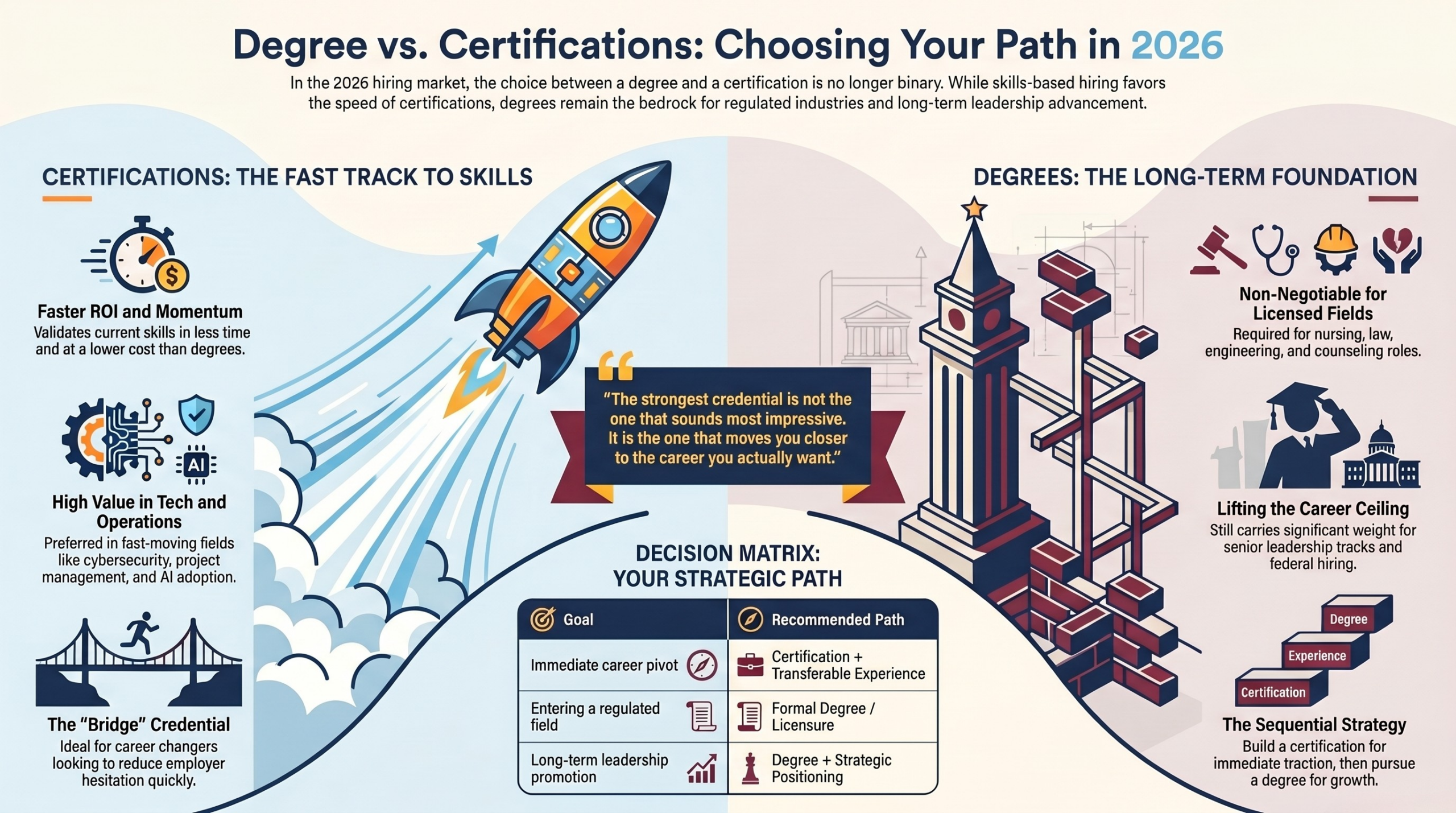
If you are deciding between a degree vs certifications, there is no universal winner. The better choice depends on the role you want, what employers in that field expect, how quickly you need results, and the return on investment you need.
In many industries, certifications can create faster momentum because they validate current skills in less time and often at a lower cost. At the same time, degrees still matter in licensed professions, leadership tracks, and roles where formal education remains part of hiring or advancement.
The smartest path is the one that closes the gap between where you are now and the opportunity you want next.
If you’d rather listen to an analogy/adaptation version of the article, click here.
Why Is the Degree vs Certifications Question More Important Now?
This decision carries more weight today because the hiring market has changed. Employers are balancing automation, AI adoption, leaner teams, and the need for people who can contribute quickly.
At the same time, professionals are navigating rising tuition costs, career pivots, and pressure to stay competitive. That combination makes educational decisions more strategic than they were a few years ago.
According to the World Economic Forum’s Future of Jobs Report 2025, technology and changing business models are expected to reshape jobs through 2030. In practical terms, that means continuous learning is becoming a career advantage rather than an optional extra.
Do Employers Value Skills More Than Degrees Today?
In many industries, yes. Hiring teams increasingly want evidence that you can solve problems, learn systems quickly, communicate effectively, and create results.
This is especially true in technology, operations, analytics, cybersecurity, project management, and fast-moving business environments. In these fields, relevance often matters more than pedigree alone.
A degree can still open doors. However, it is no longer the only signal of value.
Candidates who present clear results and practical capability often outperform candidates with stronger credentials but weaker positioning.

Why Are Certifications Becoming More Valuable?
Certifications have gained traction because they often align directly with employer demand. They can validate specific tools, systems, methods, or technical knowledge in a way that feels immediately useful to hiring teams.
They are also often faster and less expensive than another degree. For someone trying to improve short-term competitiveness, that can be a meaningful advantage.
LinkedIn Learning’s workplace learning research continues to highlight upskilling, adaptability, and internal mobility as leading priorities for employers trying to keep pace with change.
That said, not every certification carries equal value. Market recognition, relevance, and how you apply the skill still matter.
The strongest credential is not the one that sounds most impressive. It is the one that moves you closer to the career you actually want.
Can Certifications Help You Change Careers Faster?
Often, yes. Certifications can reduce employer hesitation when paired with transferable experience and strong positioning.
One client came from operations and wanted to move into project management. After earning a respected project management credential, we repositioned leadership wins, stakeholder coordination, and process improvement results to align with PM opportunities.
That combination created interview traction faster than returning to school first likely would have.
Another client wanted to pivot from customer-facing leadership into HR. We reframed coaching, communication, conflict resolution, and employee support experience, then paired it with targeted HR learning.
The credential helped. The strategy behind it made the difference.
When Does a Degree Still Matter Most?
A degree still matters significantly in many environments. In licensed professions such as nursing, law, counseling, teaching, and engineering, formal education remains part of the qualification structure.
Degrees also retain weight in some traditional corporate settings where advancement systems still favor formal education. In those environments, a degree can influence promotion potential and leadership-track opportunities.
Federal hiring adds another layer of nuance. According to the U.S. Office of Personnel Management, many qualification standards allow candidates to qualify through education, experience, or a combination of both, while some occupational series require specific academic credentials.
Sometimes a degree is less about the next role and more about your long-term ceiling.
How Do You Decide Between a Degree vs Certifications Path?
The strongest decisions begin with clarity. Instead of saying you want better opportunities, define the next role you want and the timeline you want it in.
Then study what employers repeatedly request in job postings and recruiter conversations. Patterns often reveal whether the market values degrees, certifications, licenses, portfolios, or direct experience most.
Next, identify the real gap between where you are now and where you want to go. That gap may involve eligibility, technical skill, credibility, leadership readiness, or positioning.
Finally, weigh ROI honestly. Consider cost, time, salary upside, and how much the path improves your competitiveness.
What Do Decision-Makers Actually Look For?
One of the most overlooked realities in the hiring process is that not everyone evaluates candidates through the same lens. A resume, LinkedIn profile, application, or interview answer may pass through several stakeholders, each with different priorities. Understanding those differences can dramatically improve how you position yourself.
Recruiters and HR Specialists often focus first on baseline qualifications, job titles, industry relevance, and whether your background appears aligned with the role requirements. They are typically screening for fit, consistency, and whether you meet the core criteria to move forward.
Subject matter experts tend to evaluate technical depth, credibility, and evidence that you have applied the required skills in real-world settings. They often want to see more than keywords. They look for proof of execution, problem-solving ability, and familiarity with the tools, systems, or methodologies that matter in the role.
Hiring managers usually focus on practical value. They want to know whether you can solve problems, contribute quickly, collaborate effectively, and integrate well with the team. They are often less interested in credentials alone and more interested in whether you can make their workload lighter and their team stronger.
Senior leaders frequently evaluate at a broader level. They may look for judgment, executive presence, communication skills, leadership potential, decision-making ability, and business maturity. They often assess whether someone can represent the organization well, influence others, and grow into larger responsibilities over time.
Background investigators or security reviewers may evaluate from an entirely different perspective. Depending on the industry or role, they may review employment history accuracy, credential verification, consistency of information, legal compliance, trustworthiness, financial responsibility, or eligibility for access to sensitive information. In these cases, clarity, honesty, and consistency across your records matter just as much as experience.
That is why one credential can carry different weight depending on who is reviewing your profile. A certification may impress a technical reviewer. A degree may matter more in a structured corporate environment. Strong results may resonate most with a hiring manager. Verified consistency may matter most in a regulated or security-sensitive environment.
Understanding your audience allows you to present your value in ways that matter most to the people making the decision.
Are Degrees Losing Value in the AI Era?
Not exactly. AI is changing which skills are rewarded, but it is not eliminating the value of education.
What is changing is the format of learning. Employers increasingly value professionals who continue building relevant capability rather than relying only on older credentials.
Degrees are not disappearing. Instead, they are being joined by faster, modular learning options that help professionals stay current.
What Mistakes Should You Avoid?
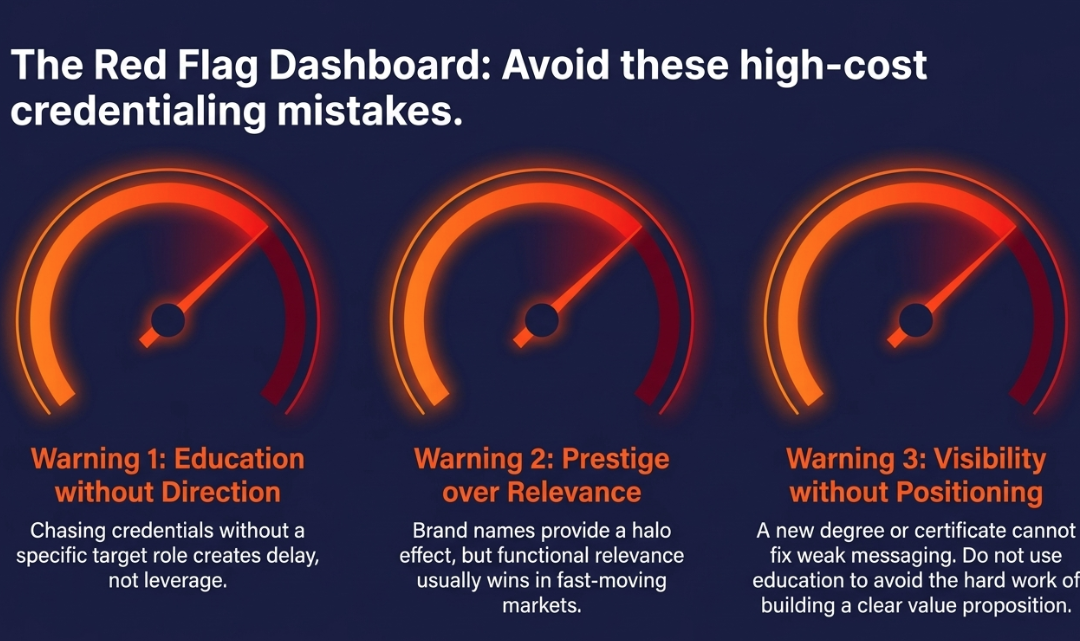
One of the most common mistakes professionals make is chasing credentials without first identifying the role they actually want. Additional education can feel productive, but when it is not tied to a clear destination, it often creates delay instead of leverage. Time, money, and energy are invested without a direct strategy for how that credential will improve hiring outcomes.
Another mistake is assuming prestige automatically guarantees return on investment. Well-known institutions and recognizable brands can carry value, but name recognition alone does not secure opportunities.
Employers are usually more focused on relevance, capability, and how well your background aligns with their immediate needs. In many cases, a targeted credential connected to market demand can outperform a prestigious option with limited practical application.
Some professionals also use education as a substitute for positioning work. Earning another credential can feel like progress, but it does not solve weak messaging, an unclear value proposition, or a resume that fails to communicate results. If employers cannot quickly understand the value you bring, even strong qualifications may be overlooked.
Visibility without positioning creates noise. Credentials are most powerful when paired with a clear narrative, strategic branding, and evidence that you can solve the problems employers need solved now.
What Is the Smartest Career Strategy in 2026?
The smartest career strategy in 2026 is no longer built on a single credential, job title, or years of experience. The market has become more dynamic than that. Employers are evaluating professionals through multiple lenses at once, including capability, relevance, communication, adaptability, and business impact.
That means the strongest professionals rarely rely on one advantage alone. They build a portfolio of strengths, then leverage those strengths intentionally.
This often includes relevant skills, credible credentials, strong communication, clear positioning, measurable results, and a commitment to continuous learning. Each element reinforces the others. Skills help you perform. Credentials can help validate expertise. Communication builds confidence. Positioning shapes perception. Results create proof. Ongoing learning keeps you competitive as industries evolve.
In a tighter and more selective hiring environment, talent alone is not always enough. Many capable professionals remain overlooked because their value is not being translated clearly to the market. Being qualified and being chosen are not always the same thing.
That is why strategic alignment matters so much.
Final Thoughts on Degrees vs Certifications
Career investments should not be driven by pressure or outdated assumptions about what looks best on paper. They should be grounded in market demand, realistic ROI, and your long-term goals.
For some professionals, a degree will be the right move. For others, certifications may create faster traction.
For many, the best answer is sequence: build the credential that supports your next move first, then evaluate longer-term education goals.
Frequently Asked Questions
Are certifications replacing degrees?
Not universally. Certifications are gaining value in many skills-based industries, while degrees remain important in regulated and traditional career paths.
Is a degree still worth it in 2026?
Often yes. A degree can still create access, credibility, and long-term advancement depending on your field.
Can I get hired with certifications only?
Sometimes yes, especially when certifications are paired with experience, measurable results, and strong positioning.
What matters most to employers?
Capability, relevance, communication, and evidence that you can deliver results.
Should I get both a degree and certifications?
For many professionals, that combination creates immediate leverage and long-term growth potential.
What is better for career changers?
Often certifications plus transferable experience can create faster momentum, depending on the target field.
How do I choose between a degree vs certifications path?
Start with the role you want next, then reverse-engineer the requirements, ROI, and hiring expectations.
Sources
- To review my answer and other expert answers on this question, go to:
Four-Year Degree or Faster Path? – ResumeExperts.TheNRWA.org - World Economic Forum – Future of Jobs Report 2025
- LinkedIn Learning – Workplace Learning Research
- U.S. Office of Personnel Management – Classification & Qualifications

You've got this, and I've got you.
#KeepGoing
- Your LinkedIn Profile Is One of Your Most Valuable Positioning Assets - July 23, 2026
- The Constraint Navigation Principle - July 17, 2026
- Support Your Career Journey This Fourth of July - July 4, 2026